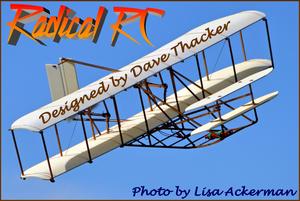
Picture shows kit with bent and painted depron wings. Yes, it will slide along pavement and ROG if you like. Pillow blocks are included for axle mounts if you'd like to create your own landing gear.
Advance Video to 1:28 to see 1905 Wright Flyer.
Choose only 1905 Wright Flyer accessories (NO KIT) below:
Winner of "1st Place CD's Choice Award" Sunday July 8 at 2012 Mid America Electric Flies.
Thanks to Ken Myers and Keith Shaw for all the hard work on this event.
This kit is an outgrowth of our stand-way-off scale Wright Stick. These kits have flown with great success all over the world for years. Many have commented how cool it would be to have the correct color, wingspan and tip shape to make the kit even more scale like. One builder, Peter Sripol made his own Depron wings and flew his at SEFF in 2011. It flew very well and looked as controllable and gentle as the version based on Slow Stick wings. In 2012 there is a possible opportunity to fly at a famous Wright location. I wanted to have a model ready should that develop further. Also, I wanted a new and unique kit for Toledo this year, we decided now was the time. This machine has all the same struts as the original 1905 Wright Flyer. The 1905 was configured a couple different ways both prostrate and seated pilot and actually carried a passenger In 1908/1909 as the first military aircraft. It was the culmination of everything Wilbur and Orville had learned from the first 2 flyers. It has a longer tail and canard moment and was the first version that truly flew well. 2009 was the 100 year anniversary of Military flight. The flyer sold to the military was essentially the 1905 Wright model 3 with seating and control modifications. So, this is a 1905 or 1908 depending on what scale detail you add.
Our Wright Stick was historic in being the first ever sport type Wright Flyer. Our new stand off scale version follows all the same scale lines in all areas possible while still keeping the model simple and rugged.
This is our second open framework kit. We hope to produce a few more in this style. A Curtis Pusher is high on my list as is the Wright EX (Vin Fizz) or perhaps the Wright B Flyer. This is a kit and not an ARF. However it assembles more like an erector set. It will fly well and you'll certainly draw a crowd. I suggest you fly it over a grass field and 10mph wind or less. I've flown in as high as 16mph but less is certainly more fun.
Picture shows kit with bent and painted depron wings. Yes, it will slide along pavement and ROG if you like. Pillow blocks are included for axle mounts if you'd like to create your own landing gear.
Did you ever get to see a Wright Flyer fly? Did you ever dream that someday you'd get to wiggle the wings on a Wright machine? I'm betting during all those many months of testing, planning, designing our famous Wrights went to bed wondering what it would be like. Then they did it. Now, you can do it. This conversion kit combined with the parts from two GWS Slow Stick slope glider kits (no longer available, discontinued by GWS) will produce a sport scale 1905 Wright Flyer. This model from the side view is scale having all the struts the original had. Omitted are all the flying wires and control cables. All the fiddly bits included on a perfect scale model (that break every time you land one) are gone. My intention was to design a model you could fly 10 times in a day if you liked and not once or twice a year for special occasions as you'd probably choose to do with a pure scale model.
Photo by SkyPielet
How does it work? If you look close you can see our unobtrusive elevator servo (we used a GWS Pico) on the canard support strut. This servo drives the top canard which in turn, drives the bottom canard through a simple transfer rod. The canards move up and down together on thier own individual pivots like the original 1905 flyer. The rudder servo is adhered to the bottom of the bottom wing with a Dubro Micro Push rod (1/32 wire in clear plastic tube) driving the rudder. The rudder moves like the original 1905, both together. Perhaps the most exciting feature is this model flys with real wing warping. The outside wing strut assembly has a servo hidden under the bottom wing driving a diagonal rod that appears to be a simple bracing rod in the scale location. Forget the Eindecker like wings, wouldn't it be gross if this model didn't turn by real wing warping? You're going to love this feature every time you show how it works.
How does it fly? I was amazed, after some initial hiccups working out the right setup. We've refined CG and throws until it flies more or less like you'd expect a trainer to fly. It is a bit draggy so you tend to fly with a middle throttle position most of the time and you will want to be comfortable flying with both hands as this design likes rudder inputs. However, you'll soon agree it flies like a trainer. Provided in the kit is the CG you need along with servo horn lengths, control throws and even exactly where to trim the canard for that first flight.
How does it build? This is not a normal kit, it's mostly nut and bolting with some foam trimming and fitting here and there a little gluing and some finishing (staining). If like me, your favorite ever childhood toy was an Erector set, you're about to feel young again! Now I know you hated those square nuts and slot head screws (I did) so we included all hex wrench driven button heads and ny-lock nuts. There is a surprising amount of aircraft ply in this kit. The main structure starts out as a 24"x24" section of 1/8" thick air ply (cuts slower on a laser) and it's packed tightly with many parts. Needless to say, there is a lot of laser cutting time here. It has the longest hardware list of any kit we've ever designed and the longest instruction set I've ever written including several drawings/templates. Ron, who built both of our in-house prototype models said he needs 3 work days to complete one. So, please plan enough time, it's very important to us that you actually finish it and get it flying. I want to hear the joy in your voice and see the pride on your face when you tell me about it at the next show.
Whats included? All the hardware needed that isn't already in the Slow Stick kits is included here. All fasteners are good quality allen head bolts with lock nuts. There are 88 washers and you can guess how many nuts and bolts.
What do you need to complete? Add 2 motors (max 2oz, 800-1200 KV), 2 stick type motor mounts, 2 ESC's, APC counter rotating prop set, electronics (2 each 6 gram servos, 2 each 20oz torque servos (we used HB-65's), and 1 each 3S battery 1800-2200mah. Extensions and Y's. For motors under 1000 kv, use 10-4.7 props, 1000-1200 kv use 10-3.8 props.


 "1905 Wright Flyer Kit Accessories Only")


 "Radical RC 1905 Wright Flyer Kit")


 "1905 Wright Flyer Depron Foam Wings Set Only")
 "Wright Stick Conversion Kit")


