
Short Answer: A Test Pilot Must Be Willing to Say “Not Yet”
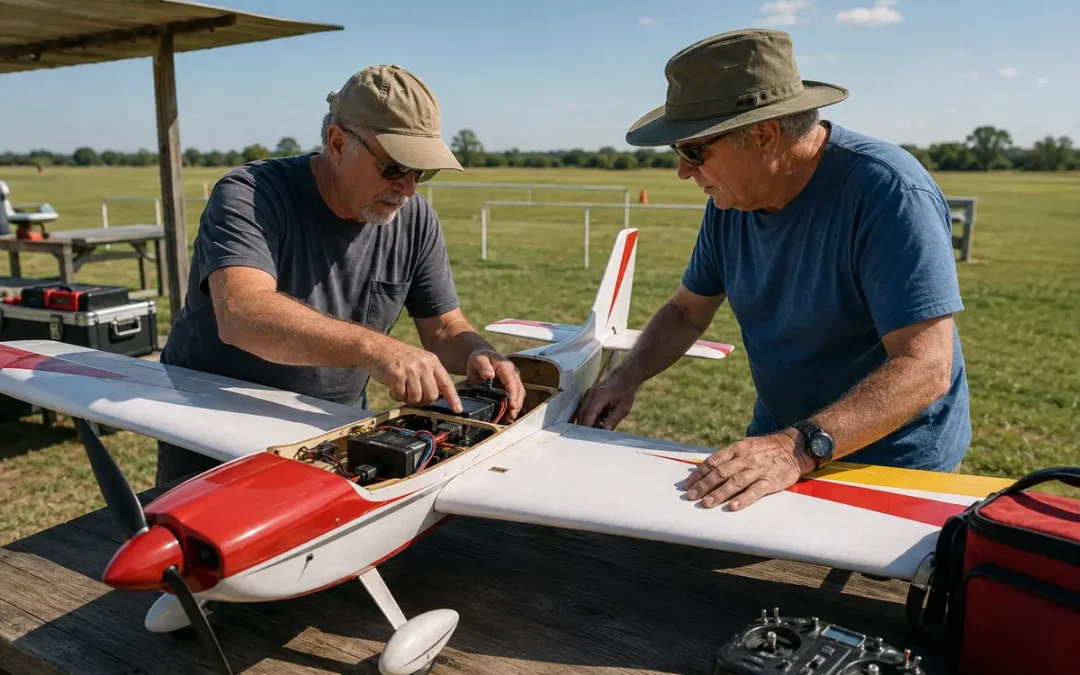
Before flying somebody else’s new RC model, inspect the model, the builder’s experience, the radio installation, and every mechanical connection that can affect control or landing. If something is not ready, the test pilot’s most important job is to say so before the model leaves the ground.
Testing a new model is an important task whether it belongs to you or a friend. Many things go into a successful test flight. I consider it a high honor to be asked, and I wrote this series from the perspective of testing another person’s model to keep the language practical.
Why Does the Builder Choose a Test Pilot?
When a modeler asks you to test-fly a model, they are choosing more than flying skill. They are relying on your experience, wisdom, and judgment. They trust you to tell them what they need to hear. If the model is not ready, say so. You were chosen both to make that determination and to fly the model if it is ready.
How Should You Assess the Modeler and the Model?
Start by sizing up both the modeler and the model. If you know the builder, ask whether the model’s complexity matches that person’s experience and flying skills. A pilot on a third model who presents a multi-engine aircraft with retractable landing gear may be reaching beyond familiar territory. That does not make the model unsafe, but it does mean the inspection deserves extra care.
Keep the conversation respectful. The builder has invested time and pride in the model. A clear explanation of a problem gives both of you a chance to fix it while the aircraft is still on the bench.
Mechanical Soundness Checklist
- Inspect every connection in a retractable-gear system and verify that the gear locks where it should.
- Check that each servo is appropriate for the model’s loads, speed, and expected performance.
- Look over every linkage for secure fasteners, adequate travel, no binding, and enough strength for the control surface.
- Examine the wheels, axles, and landing-gear mounting for landing loads.
- Inspect wiring and connectors. Secure connections that could shake loose and keep wires from flopping around inside the model.
- Make sure the battery and receiver are firmly retained. A loose battery can change the center of gravity; a loose receiver or plug can remove control.
- Check the antenna route and keep it clear of structures or wiring that could shadow or damage it.
- Look at the basics again after the model is assembled: control direction, surface movement, hinges, fasteners, and access panels.
When Should a Test Flight Wait?
If anything makes you uncomfortable, stop and discuss it with the builder. A questionable servo mount, marginal linkage, loose receiver, poorly retained battery, damaged wire, or uncertain retract connection is a bench problem, not a flight-test challenge. Fix it, have another experienced person review it, or postpone the flight.
Before flying, follow the aircraft, radio, battery, club, and field procedures that apply to the model. The current AMA Safety Handbook collects the organization’s model-aircraft safety practices. The FAA’s AC 91-57C provides additional recreational model-aircraft and UAS operating guidance. These references do not replace the manufacturer’s instructions or a sound mechanical inspection.
Continue the Test-Pilot Series
This is Part 1, focused on mechanical soundness. Continue with Part 2: Setup, Part 3: On the Wheels, and Part 4: Trim, Pre-Flight, and Flight Plan. The complete series is collected in Radical RC’s test-pilot category.
Related Radical RC Resources
See the How To? articles, onboard electronics, radio sets, and hardware sections when preparing a model.
To be continued…….