
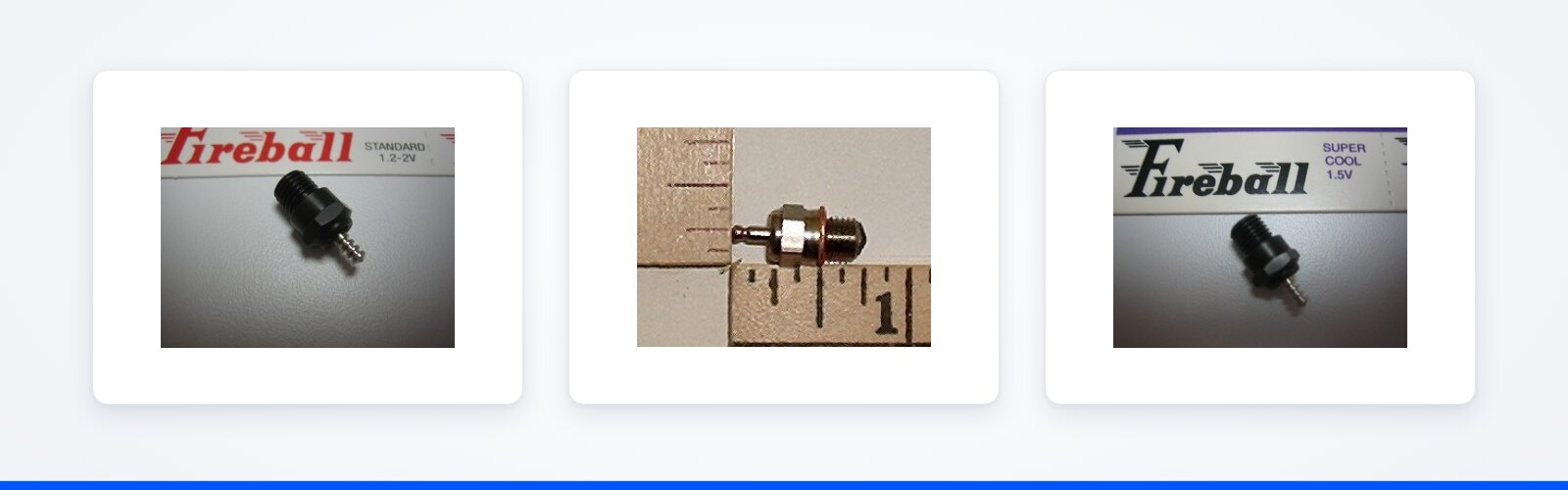
A glow plug is about the cheapest part in your airplane and the one most likely to leave you standing in the pits pulling on a prop. We sell a lot of them and we get asked about them constantly, so here is how we sort them out at the shop.
What a Glow Plug Actually Does
You put 1.5 volts across the plug to light the element and start the engine. Once it is running you pull the driver off and the plug keeps firing on its own. The platinum element reacts with the methanol in the fuel and stays hot from that reaction plus the heat of compression. That is the whole trick. There is no ignition system, no timing, no points. The plug is the ignition.
Because the plug is doing the timing, its heat range changes how the engine runs. A hotter plug fires the charge a little earlier. A colder plug fires it a little later.
Heat Range: Hot, Standard and Cold
Nitro content and compression drive the choice. More nitro burns hotter, so it wants a colder plug. Less nitro wants a hotter plug.
| Heat range | Use it when |
|---|---|
| Hot | Low nitro or no nitro. Starts fast, especially in cold weather, and idles well. |
| Standard | General sport flying. This is where most people should start. |
| Cold | High nitro, or high compression and high head temperature. |
Swanson’s Fireball plugs are color coded by the insulator, so you can tell them apart at a glance: red for hot, yellow for standard, blue for super cool and silver for their coldest. The O.S. #8 is a medium-hot plug and the most widely used plug O.S. makes. It suits most two stroke engines.
If you are guessing, buy standard, then pay attention. An engine that sags at idle and quits when you throttle down is often telling you the plug is too cold for it. An engine that runs rough at full throttle, gets hot, or eats elements wants a colder plug.
Long or Short?
This one catches people. Length is not a preference. It is what your cylinder head was machined for.
Most .15 engines and everything from .18 up take a long plug. Engines .12 and under take a short plug, and some .15s do as well. Put a long plug in a head cut for a short one and the element hangs down where the piston can find it. That is an expensive mistake. Use caution with O.S. MAX and YS engines in particular, where the wrong plug can damage the cylinder head.
Idle Bars and Four Stroke Plugs
An idle bar is a small wire across the face of the element. It keeps raw fuel off the element at low throttle, so an engine that loads up and dies coming back to idle will often clean up with an idle bar plug. If you taxi a lot or fly a lot of low throttle, try one.
Four strokes are their own thing. They take a shielded long reach plug, where the shield holds heat in so the plug stays lit at the lower idle speeds a four stroke turns. The O.S. Type F is the common one and it is meant for fuel in the 5 to 15 percent nitro range. Sonic Tronics makes Glo-Devil four stroke plugs in an O.S. version and a non-O.S. version for Enya, Saito and HP engines. Do not mix those two up. The wrong one in an O.S. four stroke can damage the head.
Knowing When a Plug Is Done
Pull it and look at it. A good element is a clean, evenly wound coil sitting up in the middle of the plug. A dead one is sagged, stretched, distorted or simply broken. Sometimes the coil looks fine and the plug still will not light, so put your driver on it and see whether it glows evenly and brightly.
Plugs are a consumable. A lean run, a hydraulic lock, a nose-over or just hours of use will finish one off. Keep spares in the field box, because the plug is the first thing to swap when an engine that ran fine last weekend will not start today.
One last thing. The Glo-Devils come with copper sealing washers and you should use a fresh one. A crushed, reused washer leaks compression and looks exactly like a bad plug while you chase your tail.
You can see the rc glow plugs we carry here, and the glow plug drivers to light them are on the next shelf over.
Related gear at the shop: