
Short Answer: Stop Using the Swollen LiPo and Contact a Qualified Disposal Program
A swollen LiPo (lithium-polymer) battery is damaged and can be a fire hazard. Stop using it and do not charge it. Do not puncture, crush, open, modify, intentionally discharge, connect a load to, or short-circuit the pack. Contact the battery or equipment manufacturer, your local household hazardous-waste program, or a qualified battery recycler and ask whether it accepts a swollen or damaged LiPo battery and exactly how it wants the battery handled and delivered.
Do not put a LiPo battery in household trash, a municipal recycling bin, or an ordinary retail battery collection box unless that specific program confirms that it accepts damaged batteries and gives you instructions. EPA says lithium-ion batteries belong at separate battery-recycling or household-hazardous-waste collection points, not in household garbage or recycling bins.
Important update: This article was originally published in 2012. The original version documented Radical RC’s shop practice at that time, but it should not be used as current disposal guidance. This revision replaces that procedure with current guidance from the U.S. Environmental Protection Agency (EPA) and the U.S. Department of Transportation’s Pipeline and Hazardous Materials Safety Administration (PHMSA).
Why This Page Corrects the Original 2012 Guidance
The original 2012 article described a shop practice for a swollen pack: using an automotive bulb to discharge it, carrying out that discharge in an ammo box, leaving it connected until the next day, and soldering the battery leads together before putting the pack into a recycling container. That was the old guidance on this page.
That procedure is outdated and should not be followed. In particular, do not attempt bulb discharging, ammo-box discharge, soldering the leads together, or any other intentional discharge or deliberate short circuit. A swollen battery can contain stored energy even when it appears depleted, and adding heat, tools, pressure, or a short circuit can create additional risk. This update does not endorse or validate the old procedure.
What Should You Do When a LiPo Battery Swells?
- Stop using and charging it. Disconnect it from the model or equipment only if doing so does not require force or disturb the pack. Do not continue testing it with a charger.
- Do not work on the cells. Do not puncture, crush, cut, open, bend, dismantle, modify, solder, intentionally discharge, or connect the leads together. Do not try to make a swollen pack look electrically empty.
- Keep it away from combustible material. If the battery is cool, stable, and safe to move without squeezing or bending it, place it in a safe location away from flammable or combustible materials while you arrange disposal. Follow the manufacturer’s and receiving program’s instructions for temporary storage. Do not improvise a transport package.
- Get specific instructions. Contact the manufacturer, the retailer if it offers a take-back service, your local household-hazardous-waste or solid-waste program, or a qualified battery recycler. Tell them that the battery is a swollen LiPo and describe any other damage, leakage, heat, odor, smoke, or impact.
- Leave an emergency situation. If the pack is hot, smoking, sparking, leaking, rapidly changing, or presents an imminent fire risk, move people away, avoid handling it, and call emergency services. Do not attempt to package or transport it yourself.
EPA’s swollen-battery FAQ says swelling indicates damage and a potential fire hazard. If there is no imminent fire threat, EPA recommends contacting the manufacturer, retailer, state waste agency, or local household-hazardous-waste program for direction and keeping the battery or device in a safe location until the disposal option is identified.
How Should You Isolate the Battery Terminals?
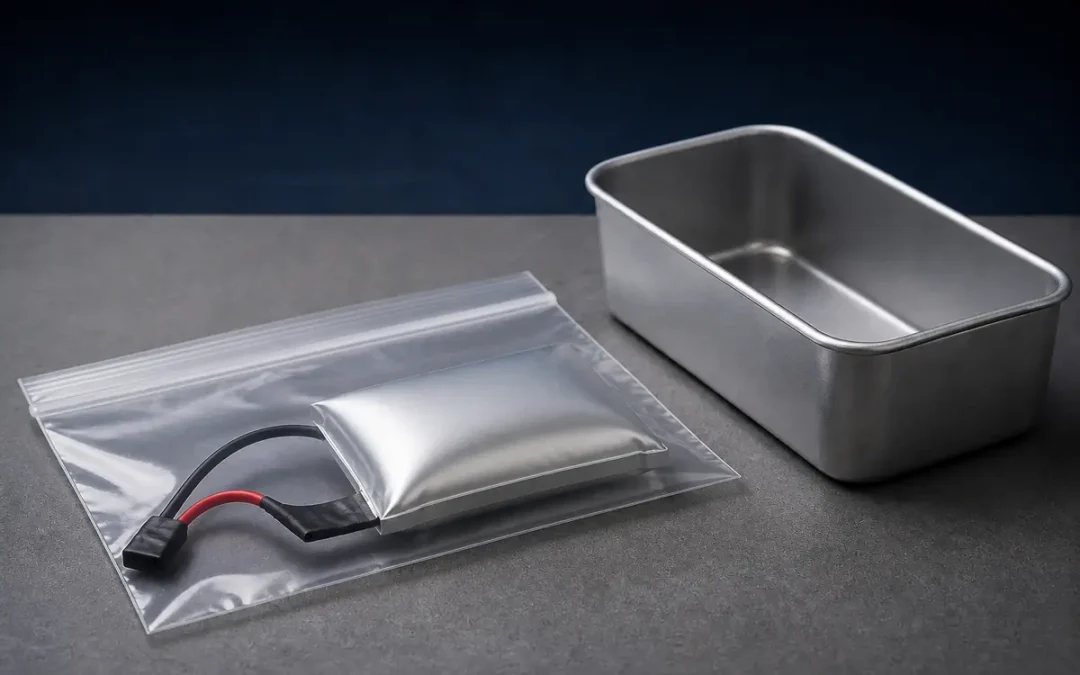
Terminal isolation prevents contact with metal or another battery. For a cool, stable battery that the receiving program says is safe to handle, EPA recommends covering the terminals with nonconductive tape, such as electrical tape, or placing each battery in its own plastic bag. Use one battery per bag; do not place loose batteries together.
A swollen or otherwise damaged pack may need additional handling instructions. Do not force it into a bag, tape over it, bend it, or otherwise disturb it just to follow a general checklist. Ask the manufacturer or receiving program what it wants done before handling the pack. Terminal isolation is not the same as making the battery safe, empty, or ready for an ordinary collection box.
What Are the Shipping Rules for a Damaged LiPo?
Do not mail or air-ship a swollen LiPo based on a generic battery-shipping guide. PHMSA explains that lithium batteries offered for transportation in commerce are hazardous materials subject to the applicable U.S. Department of Transportation rules. Damaged, defective, or recalled batteries have additional packaging, separation, hazard-communication, and transport restrictions because they are more likely to short, release heat, or catch fire.
If a manufacturer, recycler, or household-hazardous-waste program tells you to ship the battery, ask that program or its carrier for the exact packaging, labeling, carrier, and transport instructions. PHMSA’s advisory says damaged, defective, or recalled lithium batteries are forbidden from commercial transportation by aircraft and require specialized packaging and handling. That does not make every consumer transport situation identical, so do not infer a shipping method from this article.
Where Can You Take a Swollen LiPo Battery?
Start with one of these contacts and disclose the battery’s condition before you take it anywhere:
- The battery or model-equipment manufacturer, following its recall and disposal instructions if applicable.
- Your local household-hazardous-waste or solid-waste agency.
- A qualified battery recycler that specifically accepts lithium-ion or lithium-polymer batteries in damaged condition.
- A retailer or take-back service only after it confirms that its program accepts a swollen or damaged pack.
Acceptance rules vary. A collection point that accepts ordinary, undamaged rechargeable batteries may not be equipped or authorized to accept a swollen LiPo. Do not place a damaged pack into an unattended or general-purpose collection box without confirmation.
Why LiPo Batteries Do Not Belong in Trash or Recycling Bins
Even a battery that no longer powers a model can retain enough energy to create a short circuit or fire. Trash and municipal recycling systems can crush, sort, or otherwise damage batteries, exposing workers, vehicles, and facilities to fire risk. The recycling symbol does not mean that a LiPo belongs in a household recycling bin; use a separate battery-recycling or household-hazardous-waste channel that confirms acceptance.
Official Safety Sources
- EPA: Used Lithium-Ion Batteries — separate recycling or household-hazardous-waste collection, terminal isolation, and damaged-battery precautions.
- EPA: Frequent Questions on Lithium-Ion Batteries — swollen batteries, temporary safe location, terminal isolation, and why household bins are unsafe.
- PHMSA: Transporting Lithium Batteries — transportation hazards, commercial-transport rules, consumer recycling channels, and damaged-battery resources.
- PHMSA: Safety Advisory Notice for the Disposal and Recycling of Lithium Batteries in Commercial Transportation — additional requirements for used, damaged, defective, or recalled batteries.
Safety and legal note: This is general information for identifying a safer disposal path, not a shipping authorization or a substitute for the instructions of the battery manufacturer, receiving facility, carrier, or applicable local and federal authorities. Acceptance and transport requirements can vary by battery condition, program, location, and transport method.