
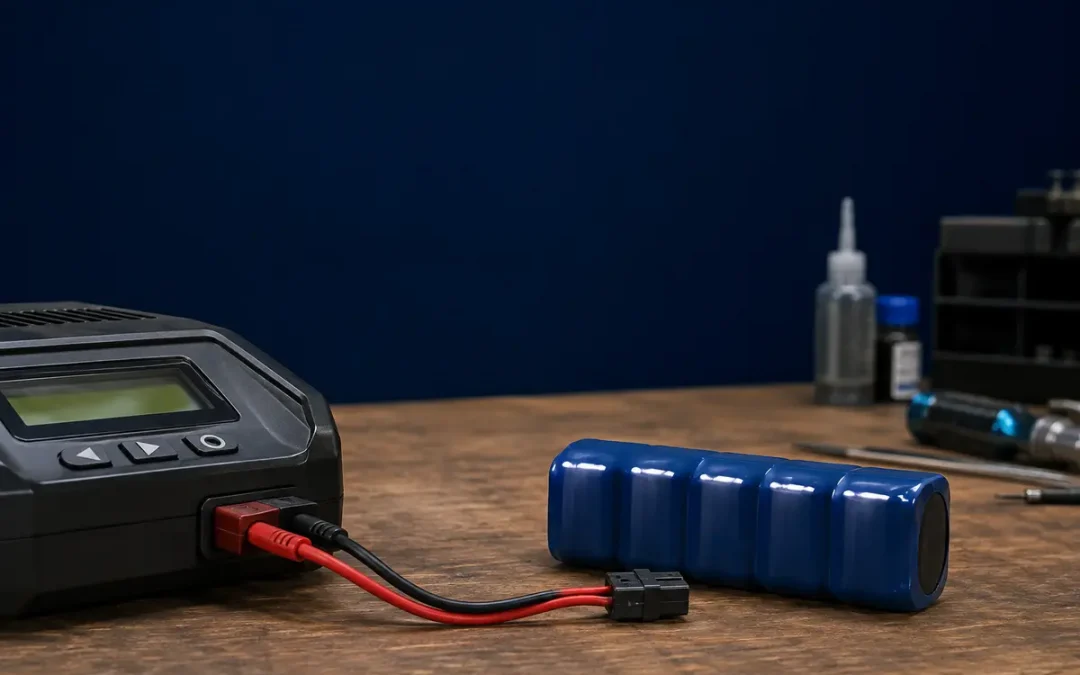
Short Answer: Use NiMH Mode and Pack-Specific Settings
Charge a five-cell NiMH receiver pack with the charger’s NiMH program and the current, cell count or nominal voltage, termination, and safety limits specified for the exact battery and charger. Do not use lead-acid (Pb) mode, enter an arbitrary 8V value, or disable the charger’s timer and capacity cutoff to make it continue charging.
A new or long-stored NiMH pack may benefit from a manufacturer-specified low-rate charge or conditioning cycle, but there is no universal forming recipe for every pack. Follow the current pack instructions and the manual for the exact Hitec X4 version on your bench.
What Was the Original NiMH Charging Question?
Ed asked how to form and charge an FDK Twicell 6.0V, five-cell, 2000mAh NiMH AA flat pack with a Hitec Multi-Charger X4. It was a reasonable question: computerized chargers provide several chemistry programs, and choosing a program that merely makes the charger start is not the same as choosing the correct one.
The current Radical RC product linked below is a 2500mAh five-cell pack, not the older 2000mAh pack in Ed’s question. Do not carry charge settings from the older pack to the newer one without checking its current specifications.
Why Is the Old Pb-Mode Procedure No Longer Recommended?
The original 2015 answer suggested turning off the mAh and time limiters, selecting Pb mode, setting 100mA and 8V, and retrying at 6V if the charger refused to start. It described this as making the computerized charger behave like a simple wall charger. That procedure is retained here as historical context, not current charging guidance.
NiMH and lead-acid batteries use different charging behavior. The Hitec X4 AC Plus manual describes a dedicated NiMH/NiCd program and states that its Pb program is for lead-acid batteries. FDK likewise says to use a charger that satisfies the battery specification, follow the specified method and time, and avoid overcharging. Those instructions do not support using Pb mode or disabled safety limits as a general NiMH workaround.
How Should You Set Up a Hitec X4 for a Five-Cell NiMH Pack?
- Confirm that the pack is NiMH, verify its five-cell/6V nominal configuration, and inspect the pack, connector, and leads.
- Select NiMH, not Pb. If the charger asks for cell count or nominal voltage, choose the setting that matches the pack.
- Set charge current only within the instructions for that exact pack and charger. Capacity alone does not establish a universally safe current.
- Keep the safety timer, capacity cutoff, and other available protections enabled and configured according to the manuals.
- Connect with correct polarity on a heat-resistant, non-flammable surface and remain present while charging.
- Stop if the charger reports an unexplained error or the pack leaks, changes shape, becomes unusually hot, or shows other damage.
Hitec’s NiMH program uses chemistry-appropriate charge termination. Its documentation also warns that incorrect termination sensitivity can overcharge a pack or stop too early, which is another reason to use the specified NiMH settings rather than a different battery program.
Does a New NiMH Pack Need Forming or Cycling?
Do not assume every new NiMH pack needs the same 50mA, 30-to-40-hour forming charge. FDK explains that the proper method and conditions depend on the cell type, pack construction, and use. Its published cell-test conditions are not automatically charging instructions for an assembled RC receiver pack.
FDK notes that batteries coming out of long storage may require several charge/discharge cycles before accepting a full charge. Use a charger’s cycle function only when the exact battery and charger instructions call for it. Cycling is not permission to change chemistry modes or guess at the current, time, or endpoint.
What If the Charger Refuses to Start?
Do not switch to Pb mode or falsify the voltage. Stop, verify polarity and connector contact, confirm the pack chemistry and cell count, read the charger’s error message, and consult the manual for your exact X4 model. A refusal to start can be valuable protection rather than an obstacle to bypass.
Relevant NiMH Pack and Current References
See Radical RC’s NiMH receiver battery packs and the current FDK Twicell 2500mAh five-cell 6V NiMH receiver pack. Use the specifications for the pack you actually own.
- Hitec product manuals — select the manual for the exact X4 charger version.
- FDK NiMH safety precautions — current manufacturer guidance on charging and abnormal batteries.
- FDK NiMH charging methods — explains why the correct method depends on the battery and application.
Dave