
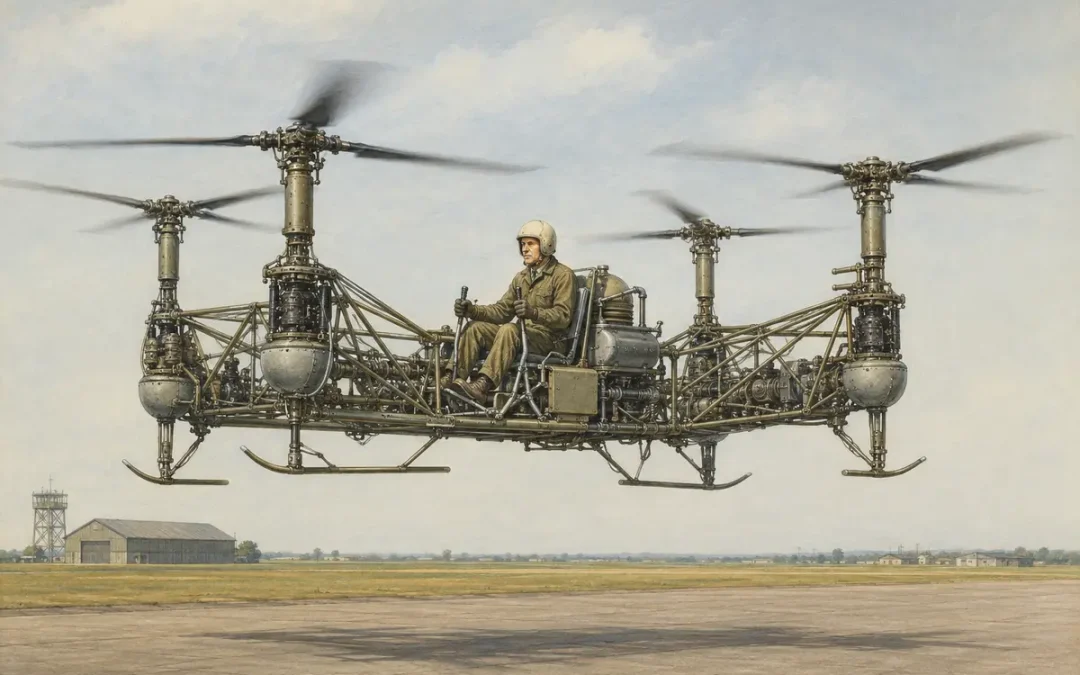
Short Answer: It Was an Early Full-Size Four-Rotor Aircraft
Yes, in the broad modern sense: the Curtiss-Wright VZ-7 was a piloted VTOL aircraft with four vertically mounted rotors. “Quadcopter” is a useful shorthand today, although the Army called the machine an aerial platform and a flying truck. It was a full-size experimental aircraft, not a forebear of today’s small consumer drones in any direct engineering or product-line sense.
The original Radical RC post dates the VZ-7’s flying period to 1958–1960 and notes that it did not meet the Army’s standards. Those two facts explain why this odd-looking aircraft is remembered as an important experiment rather than a service aircraft.

How Did Four Rotors Control a Piloted Aircraft?
The VZ-7 used four rotors arranged across its platform to provide vertical lift. Its control problem was more involved than simply adding four motors: the pilot needed to manage lift, attitude, and movement while sitting in an open platform above the rotors. A period Curtiss-Wright Aerophysics paper, “Aerophysics Aerial Platform VZ-7AP”, is the best technical starting point for the aircraft’s design and test context.
That is why the VZ-7 is such a good historical comparison for modern multirotors. The layout looks familiar, but the surrounding systems, pilot workload, and scale were very different.
Why Did the Army Experiment End?
Experimental aircraft often answer one question while exposing several others. The VZ-7 demonstrated that a compact four-rotor VTOL layout could lift a person, but the Army’s operational requirements were more demanding than simply getting airborne. The original article’s “didn’t meet Army standards” summary is therefore more useful than calling the aircraft a failure: it reached the test stage and showed where the concept still needed work.
Its unusual shape also makes the historical point easy to miss. The aircraft was designed around the practical problems of early vertical flight, not around the camera-and-battery missions that define many modern quadcopters.
Where Is the Surviving VZ-7?
The U.S. Army Aviation Museum’s current collection list identifies a VZ-7AP, serial number 58-5508, under “TSF Aircraft Not Available for Public Viewing.” That official listing is a better current status than older references that describe the aircraft as being on display. The museum’s home page and collection page are worth checking before planning a visit.
What Can RC Pilots Learn from the VZ-7?
Whenever an old aircraft looks like something from the future, it is worth remembering that the basic idea may not be new—the execution is what changes. The VZ-7 is a reminder to separate a familiar layout from the control system, power system, and mission that make an aircraft practical.
That was the spirit of the original article’s question about when the term “quadcopter” was coined. The label may be modern, but four-rotor vertical-lift experiments have a much longer history.
Related Radical RC Reading
For more unusual aircraft and early concepts, browse aviation history, multi-rotor copters, and firsts and new ideas. The original VZ-7 image is retained above; its BMP format is an archival choice rather than a newly created illustration.