
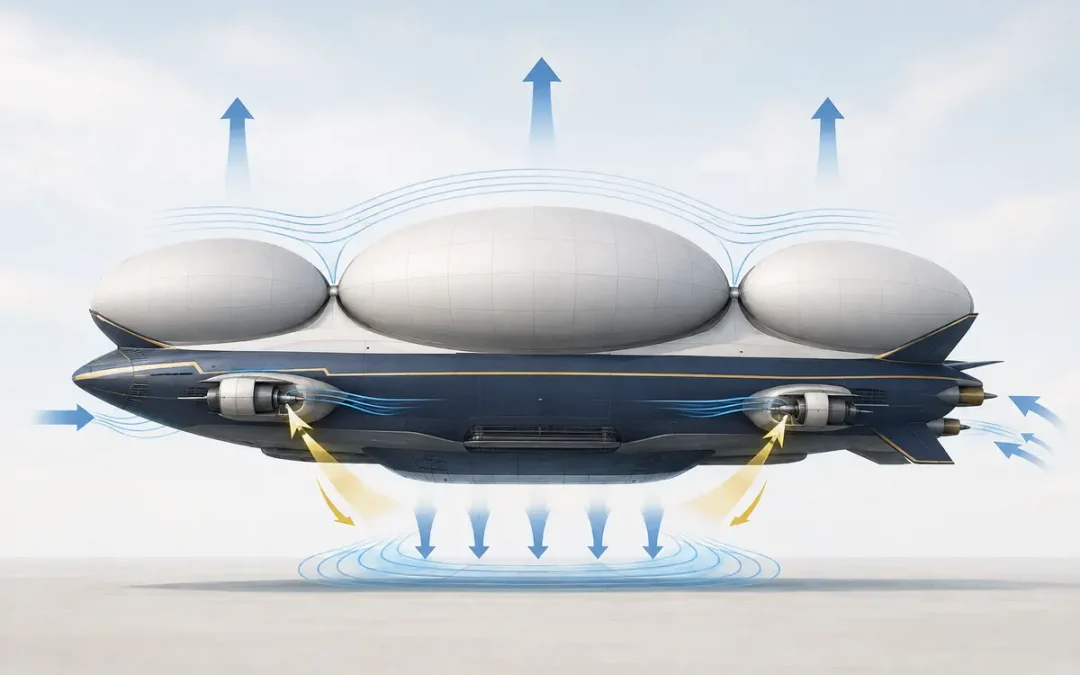
Short Answer: It Combined Helium, Hull Lift, and Vectored Thrust
The Lockheed Martin P-791 combined buoyant lift from helium, aerodynamic lift from its shaped hull, and vectored engine thrust. The two-person, half-scale demonstrator looked a little like a blimp, a lifting body, and a hovercraft had been asked to share one airframe. Lockheed Martin says the prototype flew at Palmdale, California, in 2006 and completed its flight-test objectives.
The original Radical RC note called it “an interesting flying machine.” That modest description still fits: the P-791 was not simply a lighter-than-air balloon. It was a practical technology demonstrator for combining several kinds of lift and a different way of getting an airship on and off the ground.
Why Was the P-791 Called a Hybrid Airship?
A conventional airship relies mainly on buoyant gas. The P-791 added aerodynamic lift from its shaped hull and used vectored propulsion to control its movement. AT² Aerospace, which acquired the program’s intellectual property and assets, describes the same design idea as a combination of aerostatic helium lift, aerodynamic hull lift, and vectored thrust.
That combination was meant to make the airship useful at low speed and near the ground, where a traditional aircraft and a conventional blimp each have limitations. The point was not to make a fast airplane; it was to make a large, efficient aircraft that could carry its lift with it.
How Did Its Air-Cushion Landing System Help?
Lockheed Martin’s hybrid-airship material identifies an air-cushion landing system, or ACLS, as part of the P-791’s design. In simple terms, the system was intended to provide a hovercraft-like cushion beneath the vehicle during landing and ground handling. That matters for an airship because a large hull needs a controlled way to settle, maneuver, and load without depending on a conventional runway.
The P-791 also used digital flight controls. Together, the ACLS and flight-control system made the demonstrator a useful test bed for handling a vehicle that is both buoyant and aerodynamically active.
What Made the P-791 Interesting to RC Modelers?
There is a familiar modeling lesson in the P-791: the shape of an aircraft is often a record of the compromises its designer is trying to solve. The broad hull supplies volume for helium, the body contributes lift, and the propulsion system has to work in more than one phase of flight.
For an RC builder, the interesting questions are easy to recognize. Where is the center of gravity? How much control authority remains when the model is moving slowly? How will it be restrained on the ground? Even when the full-scale aircraft is far beyond a model shop’s scale, those are the same questions that make unusual aircraft rewarding to study.
What Happened to the Hybrid-Airship Program?
Lockheed Martin announced in 2023 that the hybrid-airship intellectual property and related assets had entered a transfer portal. AT² Aerospace now presents itself as the company continuing work with that technology. That is the safe way to describe the program’s current status: the P-791 was a demonstrator, and later commercial development is a separate story rather than a production-aircraft claim.
Where Can You Read More About the P-791?
Lockheed Martin’s 2015 program release calls the P-791 a fully functional manned flight demonstrator. Its hybrid-airship brochure provides the 2006 flight-test background and explains the digital controls and ACLS. For the later program transition, see Lockheed Martin’s 2023 transfer notice and the current AT² Aerospace site.
Radical RC readers may also enjoy the site’s aviation-history articles and firsts and new ideas category. Both are good places to look when an aircraft seems too strange to fit a standard category.
Historical note: This page describes the P-791 as a demonstrator and keeps later commercial specifications separate from the prototype. The older Lockheed Martin product link formerly referenced by this article is no longer live.