
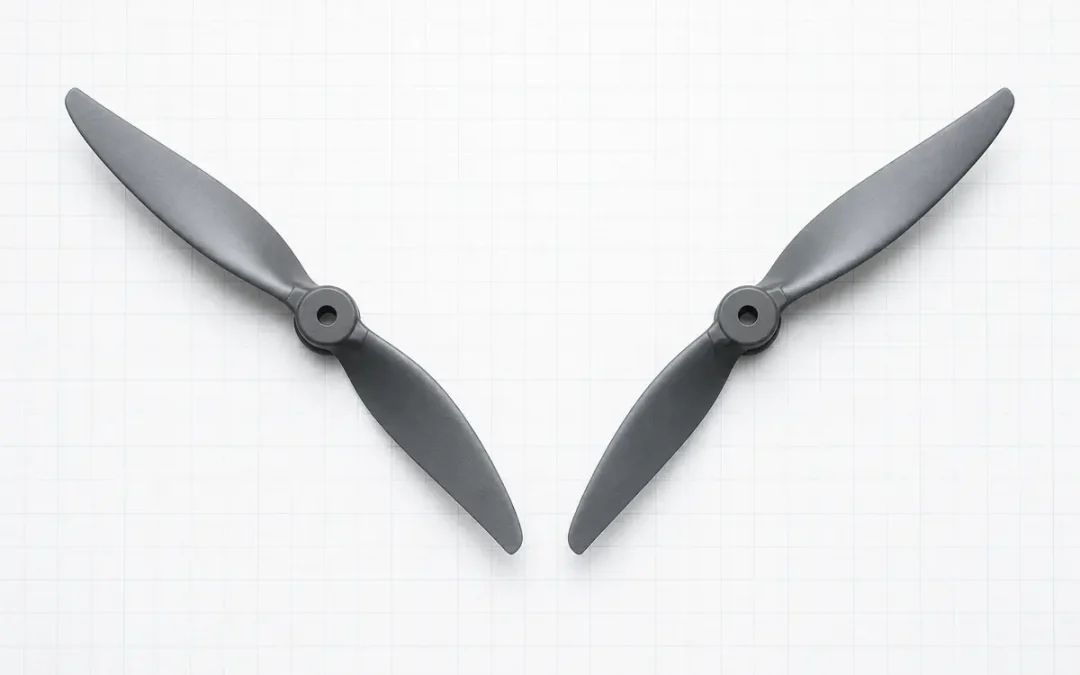
Short Answer: Use About Half-Square Pitch for Hovering
For a multirotor that spends much of its time hovering, a propeller with pitch around half its diameter—such as 9×4.5—generally produces better static thrust than a 9×6. If the power system and airframe can accommodate a larger prop, increasing diameter to something like 10×4 is usually preferable to adding pitch.
Hi Dave,
Quick question about the APC props. I note that for multi-rotor aircraft the sizes seem to use about 4.5 inches of pitch. Is there a reason I should not use, say, a 9×6 with a 9×6R for a multi-rotor craft?
Thanks,
David
Why Higher-Pitch Props Lose Static Thrust
Hovering props, or props that produce their best thrust in static air, tend to be pitched at about half their diameter or less. As you add more pitch, they can fly faster, but they have less bite in static air. They can actually be stalled and produce less lifting force until the propeller begins moving forward.
9×4.5 vs. 9×6 Multirotor Props
For a multirotor that is hovering most of the time, the lower-pitch 9×4.5 propeller is generally the better choice. The higher-pitch 9×6 can be partially stalled before it develops enough forward speed, which also helps explain why otherwise similar high-pitch props can make more noise.
Why Choose 10×4 Instead of 9×6?
If you need more propeller than a 9×4 to apply the available power to the air, move to a 10×4 rather than a 9×6. A 9×7 would be an especially poor choice for this hovering-focused setup.
When Higher-Pitch Props Make Sense
All this assumes the model is essentially hovering most of the time. Even forward flight in a typical multirotor is not as consistently forward as it is in an airplane. Other aircraft and flying styles may have reasons to use more pitch relative to diameter, but that is unlikely for most multirotors except perhaps a racer.
We call a propeller with pitch about half its diameter a half-square prop. A pattern aircraft or warbird might use a three-quarter-square prop, such as 10×7 or 11×8, or even a square prop such as 12×12. Those setups give up low-speed acceleration and static thrust in exchange for more speed once the aircraft is moving.
For the sizes discussed here, browse our APC multirotor propellers, including the APC 9×4.5 standard-rotation propeller and the matching APC 9×4.5 reverse-rotation propeller.
Dave