
A starter that is too small for the engine will not turn it through compression. You stand there cooking the motor and the battery while nothing happens. Matching the starter to the engine is most of the job, and the battery behind it is most of the rest. Here is how we size them at the shop.
Match the Starter to the Engine
Makers rate a starter by the largest engine it will spin. Stay at or under the rating and leave yourself margin, because a cold engine with heavy oil in it is a lot harder to turn than the rating suggests.
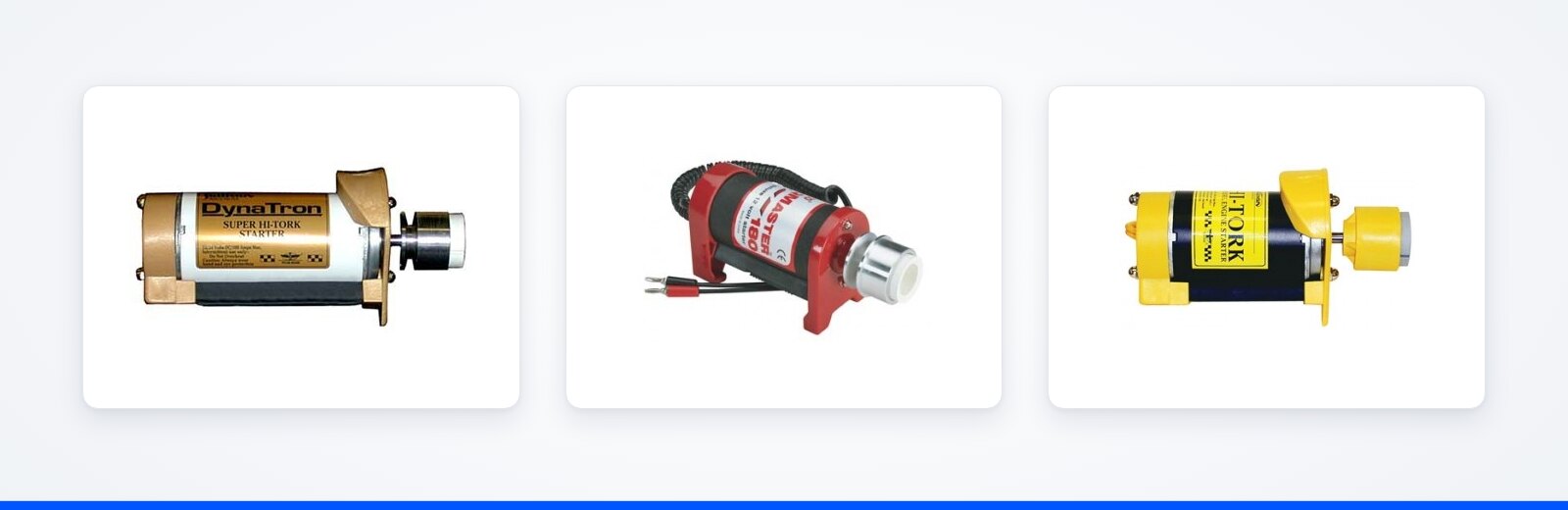
The Hobbico Torque Master 90 handles engines up to .90 cubic inch and comes with alligator clips to go straight to a battery. The Torque Master 180 goes to 1.80 and comes power panel ready with banana plugs. The Sullivan Hi-Tork 12V is a heavy duty direct drive unit that ships with a reversible driver so it works against a spinner or straight against the prop. It costs more, and of all the normal sized direct drive starters it is my favorite.
At the top of the range is the Sullivan Dynatron. It runs on 12 or 24 volts, draws up to 100 amps, and makes 340 in-oz of stall torque at 12 volts or 680 in-oz at 24. No load speed is 4800 RPM at 12 volts and 9600 at 24. It will start anything up to 2.4 cubic inches, which is 40cc, so it earns its keep on big gas engines.
If you want more torque without a bigger starter, look at the Kavan planetary gear starter. It gears down 5:1, weighs about 26 ounces, runs on 12 to 14.4 volts and turns a .60 two stroke or a .90 four stroke without complaint, all in a package smaller and lighter than a conventional starter of the same ability. It is my personal favorite.
The Battery Matters More Than the Starter
This is where most people lose torque and never know it. A starter motor pulls the current it needs, and current follows the voltage the battery can actually hold while you are pulling it. A small lead acid battery sags hard the moment you squeeze the trigger. The starter is not weak. The battery is.
The Hobbico Power Core MKII is a good battery box, but the little 1.3 amp hour lead acid cell inside is the weak link. We build a 4S A123/LithiumWerks LIFE pack that drops into the Power Core case with no modification. Nominal voltage is 13.2 volts and it holds it under load, which roughly doubles the torque you have now.
We build the same sort of insert for the Sullivan S642 battery box, and there you pick your voltage. Four cells gives 12.8 volts, five gives 16.0, six gives 19.2 and eight gives 25.6. Five cells is worth about a 13 cell NiCad, six is worth about 16 cells, and eight beats two 12 volt lead acid batteries in series. The pack comes ready to plug into the Sullivan monitor board.
If you are staying with lead acid, charge it gently. We charge the Power Core cell at no more than 100 mA, either with the Hobbico Power Core charger or a computerized charger set to PB mode.
Cones and Adapters
The cone is what actually grips, and a worn or wrong cone is why a lot of starters feel weak.
Silicone cones grip spinners better than rubber and mar plastic spinners less. Sullivan makes them in standard, medium and deep shapes to suit different spinner lengths. Pay attention to fitment. The Kavan will not take Sullivan cones, and the Hobbico TorqMaster insert is a loose fit in a Sullivan. Buy the insert made for your starter.
If you fly without a spinner there is an adapter with molded bumpers that drives on the edge of the prop blade. It is made for standard rotation only. Do not put it on a counter rotating engine.
Taking Care of a Starter
Do not lean on it. Use short bursts, not long grinds. If the engine will not fire in a few seconds, stop and find out why it will not, instead of cooking the starter and boiling the battery. A starter stalled against compression is very close to a dead short across the battery, and everything in that circuit gets hot in a hurry.
Keep the cone and the spinner clean. Oil and exhaust residue make the cone slip, and a slipping cone polishes itself and only gets worse.
The starters, cones, adapters and battery boxes are all on the rc engine starters page. And before you blame the starter for a hard starting engine, it is worth pulling the glow plug and having a look at it.