
Short Answer: Align the Blade, Match It to the Job, and Support the Work
Set up a Dremel 580 by making the blade parallel to the miter slots, choosing a properly rated blade for the material and cut, and supporting the work with the right fence, gauge, sled, featherboard, or push aid. Unplug the saw before setup or adjustment, and follow the manual for the exact saw, blade, and accessory. Once those basics are right, the compact 4-inch saw becomes a natural fit for an RC model-building bench.
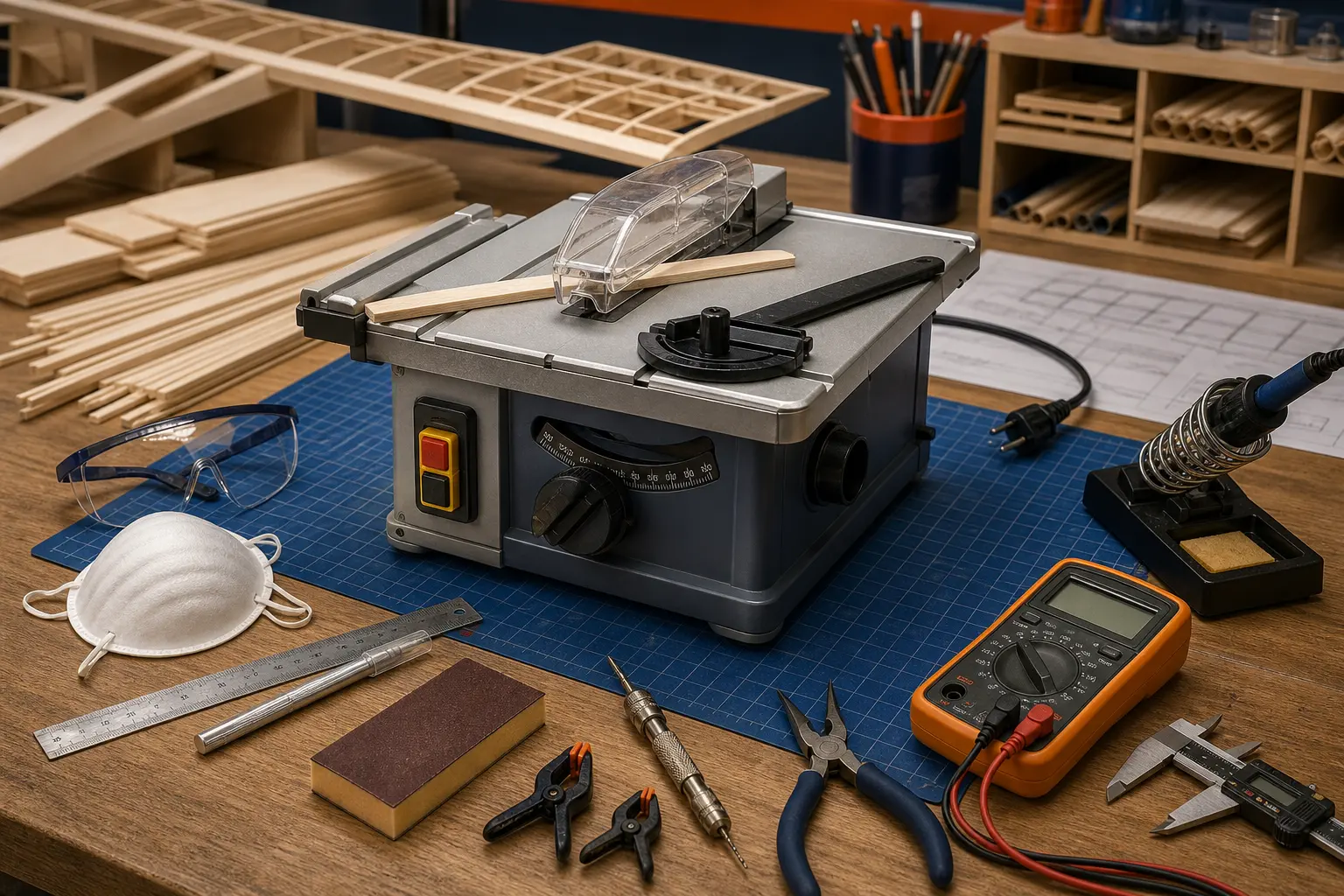
What a Small Table Saw Is Useful for in RC
A compact saw is most useful when the job calls for a straight, repeatable cut. Typical RC workshop uses include:
- Ripping balsa, basswood and thin plywood: make consistent spars, cap strips, servo rails, fuselage longerons and reinforcement stock.
- Crosscutting small parts: use a properly fitted miter gauge or sled for square, repeatable pieces such as tray rails, gussets and jig components.
- Making trailing-edge and aileron stock: stand suitable stock against a tall auxiliary fence when the saw, blade and workholding arrangement are designed for the cut.
- Building fixtures: cut runners and sheet material for sanding fixtures, assembly jigs, small sleds and alignment tools.
- Cutting selected plastics or metal: only when the saw manufacturer and accessory maker approve the material, and only with the correct rated blade or cutoff wheel. Never substitute a wood blade.
A table saw is not the best answer for every model-building job. Curves belong on a scroll saw, fretsaw or coping saw. A sharp hobby knife and straightedge are often better for very light balsa or covering film. A razor saw is easier to control for installed parts and delicate one-off cuts.
A Practical RC Workshop Tool Kit
You do not need every specialty tool on day one. A dependable core kit covers measuring, cutting, holding, finishing and electrical work.
| Job | Useful everyday tools | Common RC uses |
|---|---|---|
| Measure and lay out | Steel rule, small square, calipers, fine pencil | Spars, control throws, hole spacing, motor and servo mounts |
| Cut and shape | Hobby knife with spare blades, cutting mat, razor saw, sanding blocks, needle files, pin vise | Balsa, plywood, plastic, dowels, slots and small holes |
| Hold and assemble | Small clamps, spring clamps, weights, machinist blocks, magnetic or pin board | Keeping wings, fuselages and jigs straight while adhesive cures |
| Fasteners and linkages | Quality screwdrivers, hex drivers, nut drivers, needle-nose pliers, flush cutters | Landing gear, servo mounts, wheel collars and control hardware |
| Electrical work | Temperature-controlled soldering iron and stand, wire stripper, heat-shrink tools, digital multimeter | Connectors, battery leads, continuity, voltage and polarity checks |
| Personal protection | Safety glasses, suitable dust protection, hearing protection when needed | Cutting, sanding, drilling and soldering operations |
Buy the tools you will use repeatedly, and keep them in fixed locations. A sharp blade, a square that stays square and a soldering iron with a clean tip save more time than a drawer full of marginal tools.
Get the Dremel 580 Cutting Straight First
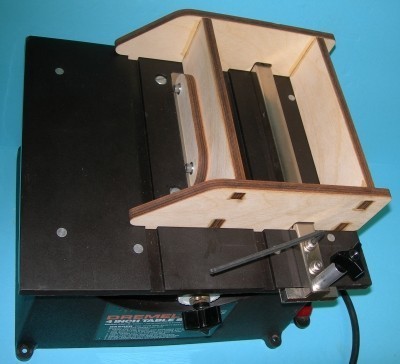
The Dremel 580, 580-2, 588 and 588-2, plus Craftsman and Montgomery Ward saws built on the same casting, use many of the same parts. Out of the box—or after decades of use—these saws are often not aligned well. People blame the motor when the real problem is setup.
Start by making the blade parallel to the miter slots and centering it within the available adjustment. Correct alignment keeps work from binding between the fence and blade, reduces sideways creep on crosscuts, and lets the motor spend its power cutting rather than fighting friction.
Radical RC makes a laser-cut Dremel table saw setup jig kit for this job. Once you can see what is moving and what must remain parallel, the adjustment is straightforward. Do it before judging a new-to-you saw or adding other accessories.
Choose the Blade for the Job
| Blade | Best use |
|---|---|
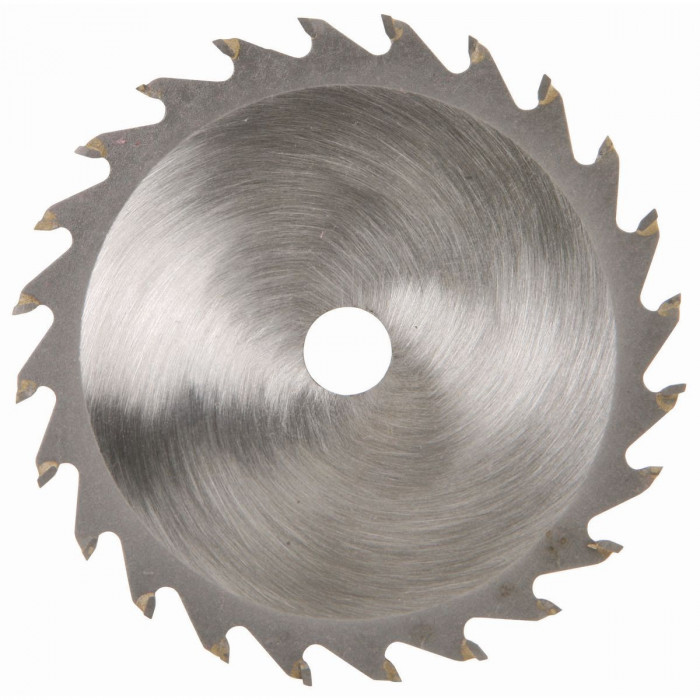
| 24-tooth carbide | General ripping and faster cuts. C2 tungsten-carbide tips, 0.078-inch kerf, 1/2-inch arbor, rated to 14,000 RPM. |
| 36-tooth carbide | A high-quality option when a finer carbide cut is preferred. |
| 40-tooth carbide | Narrow 0.059-inch kerf and alternate-top-bevel teeth for a precise finish. |
| 40- and 66-tooth steel | US-made high-carbon-steel replacements for the original Dremel combination blade No. 8003. |
| 200-tooth steel | Very thin 0.015-inch plate and 0.027-inch rim for cutting strips with minimal waste and a fine finish. Replaces Dremel fine blade No. 8004. |
The 200-tooth blade must be mounted between precision support discs. Its plate is thin enough to flex, and the arbor nut will not seat properly without the discs. Do not run that blade without them.
Our blades have a 1/2-inch arbor hole. If your saw needs a 3/8-inch arbor, request the bushing with your order. A blade or cutoff wheel with a 5/8-inch bore needs the appropriate centering collar or adapter nut. Always confirm the wheel material, diameter, arbor fit and RPM rating against the saw and accessory instructions before switching materials.
Hold the Work, Do Not Fight It
The factory rip fence is short. An auxiliary rip fence slips over it without fasteners and adds the height needed for supported edge work. Featherboards act as an extra hand by maintaining light, consistent pressure against the table and fence. A zero-fit kerf plate closes the open area around the blade so small pieces are less likely to drop into the slot.
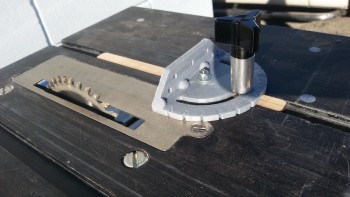
For crosscuts, use a properly fitted miter gauge or purpose-built sled—never guide the work freehand. Radical RC’s miter gauge uses a precise aircraft-plywood runner, a tough ABS body, a clamping-handle riser and an improved knob. Precision runner stock is also available for builders making their own jigs and sleds.
Dremel 580 Maintenance Checklist
After each work session
- Unplug the saw before cleaning or reaching near the blade.
- Brush or vacuum away balsa dust and chips. Do not blow debris into the motor, switch or bearings with high-pressure air.
- Clean the miter slots and fence contact surfaces so the next setup starts square.
- Check that no offcut is trapped beside or below the blade.
Before the next cutting session
- Inspect the blade for missing teeth, cracks, warping or heavy buildup. Replace damaged blades; do not try to straighten them.
- Confirm that the blade, support discs when required, arbor nut, kerf plate, fence and safety devices are correctly fitted and secure.
- Turn the blade by hand only while unplugged to check for rubbing or unexpected resistance.
- Inspect the power cord and switch. Stop using the saw if insulation, grounding or switch operation is questionable.
Periodically
- Recheck blade-to-miter-slot alignment, especially after transport, a blade change or a hard bind.
- Inspect the drive belt for glazing, cracking, stretching or tracking problems. A slipping belt can feel like a weak motor.
- Check the rip-fence screws, kerf-plate screws, arbor nut and control knobs for wear or looseness.
- Keep the saw dry and covered when it is not in use. Keep oil and wax away from belts, blade teeth and material-gripping surfaces.
Small Parts That Commonly Wear Out
Belts stretch and crack. The Radical RC replacement is more than 50 percent thicker than the stock belt at 0.031 inch and is designed to run smoothly. The 10-inch belt fits the 580, 580-2, 588 and 588-2; the Craftsman 572-2474 and Montgomery Ward Power Kraft TDR97501 use the same size.
Other commonly missing or damaged pieces include kerf-plate screws, rip-fence adjustment screws, the arbor blade nut, and the knobs for the fence and miter gauge. The Dremel-thread arbor nut also fits the related Montgomery Ward and Craftsman saws built by Dremel.
Essential Table-Saw Safety
- Wear eye protection. Use suitable dust collection or respiratory protection for the material being cut.
- Disconnect power before changing blades, clearing jams, making alignment adjustments or cleaning near the cutting area.
- Use installed guards and safety devices. Keep the blade as low as the operation safely permits.
- Use a push stick, featherboard, sled or other suitable aid to keep hands away from the blade. Do not reach over or behind a moving blade.
- Never make freehand cuts. Support the work against the correct fence, miter gauge or jig, and do not combine the rip fence and miter gauge in a way that traps the offcut.
- Stand out of the likely kickback path. Do not force the feed; stop if the blade slows, the work binds or the cut begins to wander.
- Secure long hair and loose clothing. Avoid loose gloves around rotating machinery.
- Let the blade stop completely before retrieving offcuts or leaving the saw.
Once the saw is aligned, correctly bladed and safely supported, it becomes a precise model-building tool instead of a frustrating little machine. Browse all available Dremel table saw parts and accessories, or read a builder’s first feedback after using the setup jig.