

Short Answer: Compare Both Voltage and Usable Capacity
Converting a model from LiPo to A123 or LiFePO4 cells is not a matter of matching the pack labels. Compare nominal and full voltage, usable capacity, current capability, weight, and the limits of the ESC, motor, BEC, propeller, wiring, and charger. Then verify the complete system with a wattmeter before flying.
Dave’s original 9S LiPo example remains a useful way to do the first calculation. It is a starting point, not a promise of equal watts, RPM, duration, or handling.
What Did Chris Ask About His Ryan?
Chris from Michigan wanted to power his Ryan with A123 cells. He was using a 9S, 4P, 6,000mAh LiPo pack with a Hacker C50 motor and asked whether four 6S, 2,300mAh A123 packs would provide the same watts and flight duration. Because A123 cells cost more, he wanted to check the order before buying.
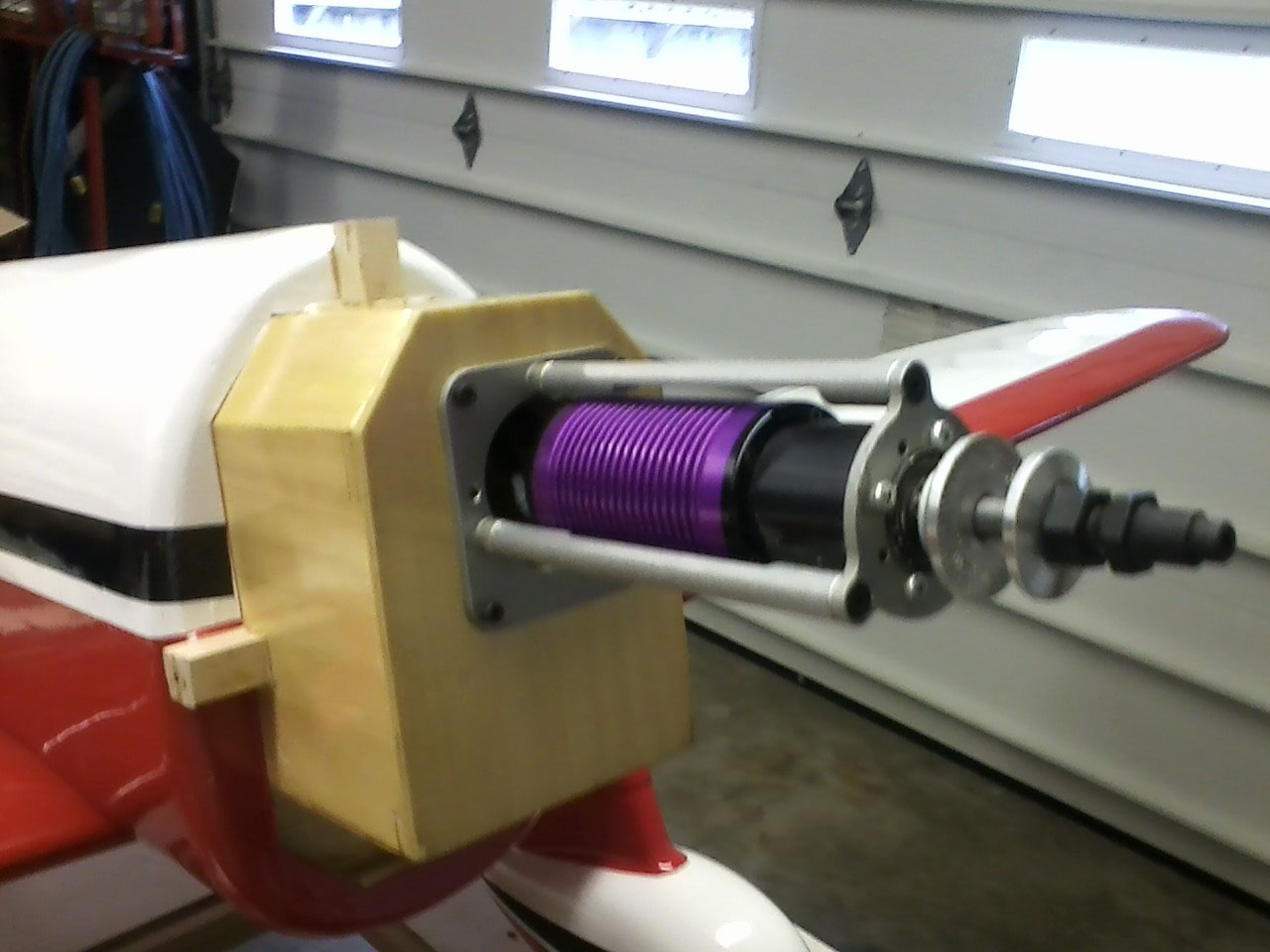
The original post includes photographs of the Ryan and the red-and-white model on the workbench. The motor photograph shows the Hacker installation. Those photographs are worth keeping because they make the power-system question concrete.

How Do LiPo and A123/LiFePO4 Cell Voltages Compare?
| Chemistry | Nominal cell voltage | Typical full-charge reference |
|---|---|---|
| LiPo | 3.7V | 4.2V per cell |
| A123/LiFePO4 | 3.3V | 3.6V per cell |
These are common charger-reference values, not permission to use the wrong chemistry program. Confirm the exact cell data sheet and charger settings. A123 is a brand name; current equivalent cells may be sold as LiFe or LiFePO4 with different ratings.
How Many LiFe Cells Replace a 9S LiPo Pack?
For a first nominal-voltage comparison:
(number of LiPo cells × 3.7) ÷ 3.3 = approximate LiFe cell count
For a full-charge comparison:
(number of LiPo cells × 4.2) ÷ 3.6 = approximate LiFe cell count
For 9S LiPo, the original calculations are 33.3V nominal divided by 3.3V, or about 10.09 LiFe cells; and 37.8V full divided by 3.6V, or 10.5 LiFe cells. Since the model spends much of a flight between full and nominal voltage, Dave leaned toward 11S rather than 10S. Ten cells may give slightly less performance, while eleven may require a smaller propeller or a careful ESC check.
The old article quoted 40.4V as the starting voltage for 11 A123 cells and estimated a 1,300 RPM increase with a 500KV motor. Using the 3.6V-per-cell maximum in current charger guidance gives 39.6V for 11S, not 40.4V, so those two figures should be corrected before publication. At 500KV, 10S LiFe full voltage is 36.0V and 11S is 39.6V; compare each with the original 37.8V LiPo figure and check the actual motor and propeller load.
How Much A123 Capacity Is Needed?
To match the nominal 6,000mAh capacity, three 2,300mAh cells in parallel would be the nominal 3P arrangement. Dave observed that the cells he tested often delivered about 2,200mAh, which would make 3P about 6,600mAh in that historical example. Treat that as a firsthand observation, not a current specification for every cell.
Dave assumed Chris meant four 1,500mAh LiPo packs in parallel, which equals 6,000mAh total. He also pointed out that if “6,000mAh cells, four in parallel” meant 24,000mAh in the airplane, the A123 replacement would be roughly 11P—probably not what Chris intended. Spell out the series and parallel arrangement whenever a pack is described.
Four 6S, 2,300mAh packs are not automatically equivalent to a 9S, 4P, 6,000mAh pack. Series count determines voltage; parallel count determines capacity. Draw the proposed pack as series groups and parallel groups before ordering, and check its maximum current, connector, balance lead, weight, and physical fit.
What About Using Only Part of the LiPo Capacity?
Dave’s rule of thumb was to use roughly the top 60 percent of a LiPo routinely, with 70 percent as a maximum, and he was more comfortable using A123 cells somewhat deeper because reaching BEC cutoff worried him less; he considered a BEC cutoff especially hard on a LiPo. His example treated 60 percent of 6,000mAh as 3,600mAh and 70 percent as 4,200mAh; a 2P A123 arrangement at about 4,400mAh could therefore look close in practice.
Those depth-of-discharge assumptions depend on the exact battery, current, cutoff, temperature, and flight style. Do not use them as a guarantee. Set a conservative timer, land with reserve, and measure the pack and power system under real conditions.
What Must Be Checked Before the First Flight?
- Confirm that the ESC, BEC, motor, and charger support the replacement chemistry, cell count, and maximum voltage.
- Check motor RPM, current, and watts with the intended propeller and a wattmeter. A cell-count conversion alone cannot predict propeller load.
- Compare pack weight, center of gravity, physical dimensions, connectors, balance leads, and secure mounting.
- Use a documented A123/LiFe charge program. Never charge LiFe cells with a 4.2V-per-cell LiPo setting.
- Make a short, conservative test flight and inspect voltage, temperature, connectors, and capacity afterward.
Dave’s practical propeller suggestion was to try about an inch more pitch with 10S A123 or about an inch less with 11S, if a suitable propeller and the measured power load support that change. He also warned that 12S would likely put the model well above the original 9S LiPo RPM and wattage. A worn or voltage-depressed LiPo can make an A123 replacement appear stronger than the original pack, so compare a known-good baseline where possible.
Original Power-System Photographs
Related Radical RC Resources
See the A123/LiFePO4 cells and packs, chargers, and LiPo and LiFe balancers. The lithium safety guide and lithium-polymer applications guide are useful companion reading.
- A123 ANR26650 technical data
- Horizon charger manual — chemistry voltage references and charger safety
Dave