
The Flight in One Minute
James May and a team of modelers and aerospace students built a giant balsa glider for the 2012 Toy Stories special “Flight Club.” They intended to fly it about 22 miles from England to France, but permission to enter French airspace was not granted. The successful mission instead launched from North Devon and reached Lundy Island across the Bristol Channel.
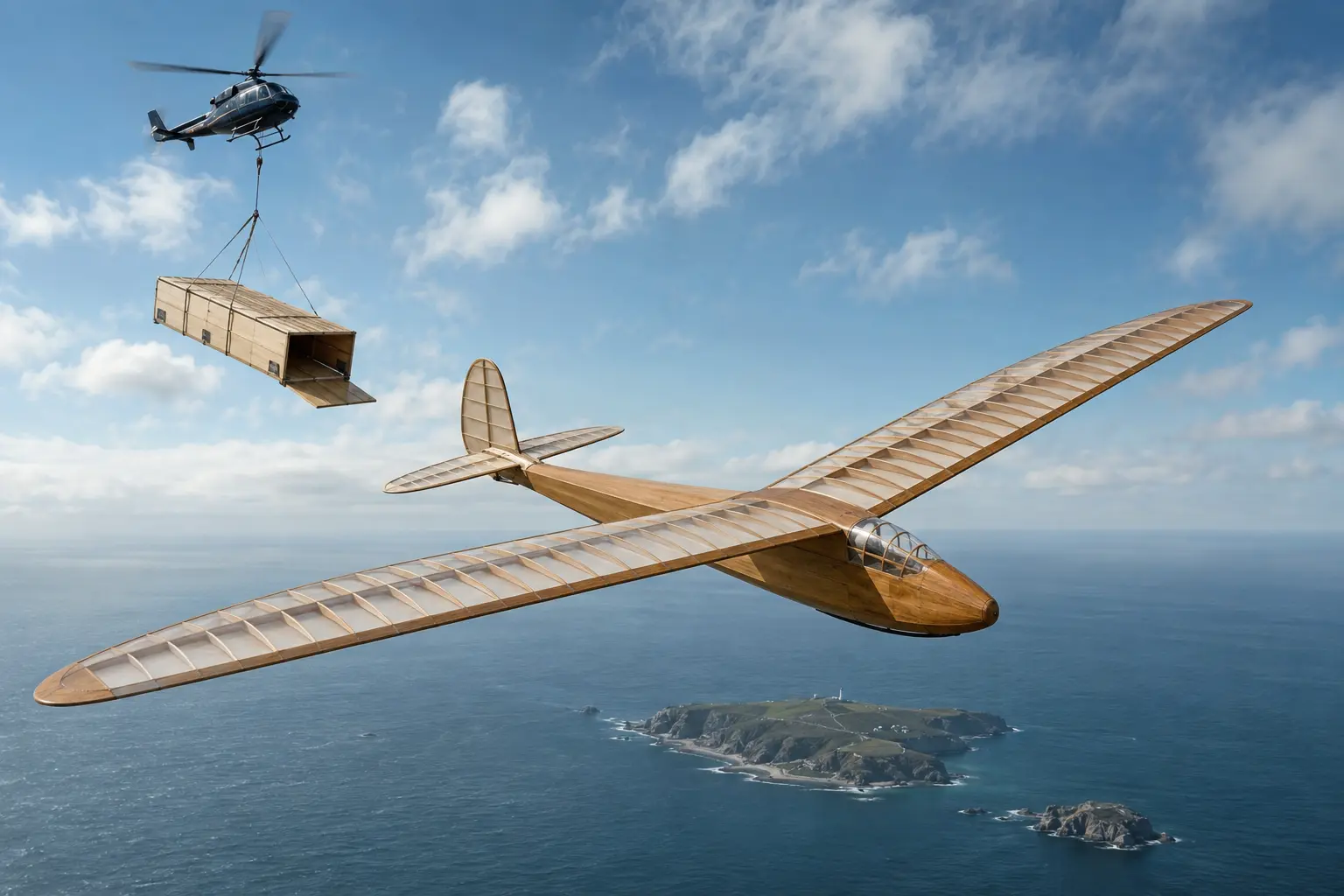
The unpowered model was based on the Slingsby T.45 Swallow sailplane. It carried an autopilot, GPS, tracking equipment, cameras and a radio-control override. Released from a purpose-built crate beneath a helicopter at roughly 10,000 feet, it navigated to Lundy, circled above the island and landed safely in less than an hour.
Did the Glider Cross the English Channel?
No—not in this project. The English Channel was the original goal, not the route of the successful flight. The production planned a Dover-to-Calais attempt, but French authorities would not permit the unmanned aircraft to enter French airspace. The team moved the challenge to the Bristol Channel, first aiming from North Devon toward South Wales and then changing the destination to Lundy Island when the weather made the Welsh route impractical.
| Stage | Route and result |
|---|---|
| Original plan | Dover to Calais, approximately 22 miles. It was abandoned when permission for French airspace was not obtained. |
| First Bristol Channel attempt | Ilfracombe toward Oxwich Bay on September 21, 2012. Low cloud forced a much lower release, and the attempt ended only a few nautical miles from launch. |
| Successful flight | From above the Woolacombe area to Lundy Island on September 22, 2012. The glider reached the island in about 38 minutes and landed in less than an hour. |
What Kind of Glider Did James May Build?
The project used a large-scale model of the Slingsby T.45 Swallow, a British club sailplane introduced in the 1950s and also used by the Royal Air Force’s Air Training Corps. Its roomy fuselage was useful for the cameras, batteries, tracker and flight-control equipment, even though that shape added drag.
The model was a serious piece of traditional construction. More than 1,000 balsa pieces went into the airframe, along with laser-cut plywood parts and heat-shrink covering. The team assembled the wings, tail and fin in an aircraft hangar while James May and an assistant worked on the fuselage. Even the final sealing around the wing roots involved the familiar model-builder combination of custom parts and carefully applied tape.
Published accounts disagree over the scale: the 2015 Brunel engineering paper calls the original model quarter-scale, while the Royal Aeronautical Society’s account says one-fifth scale. The redesigned wing was extended to about 3.9 meters, so the finished aircraft was no longer strictly scale in any case.
Why the First Wing Was Not Good Enough
A glider crossing open water has only the altitude and energy it starts with. If its lift-to-drag ratio is too low, no amount of hopeful steering will make it reach the far side. Testing in the University of Southampton’s R.J. Mitchell Wind Tunnel showed that the original configuration did not have enough performance margin for the planned crossing.
Brunel University students and engineers reworked the wing rather than simply launching higher and hoping for the best. They changed the airfoil sections at the root and tip and increased the span. Computer modeling predicted a glide ratio near 19:1 after the redesign—enough to make the mission practical with a suitable release altitude and weather window. The redesigned wing was not tested in the wind tunnel again; estimates derived from the actual flight later fell between about 15.8:1 and 16.6:1.
That sequence is probably the most valuable part of the project for any modeler: build, measure, find the weak point, revise the design and test again. The television challenge was entertaining, but the successful airplane came from ordinary engineering discipline.
How Could an Unpowered Model Fly 22 Miles?
The glider did not have an engine, but it was not a conventional free-flight model. An ArduPilot-based system used GPS waypoints to hold the planned course. A radio-control pilot was available to take over if necessary, as required for the operation, and a separate tracker helped the support crew follow the aircraft. Three small onboard cameras recorded the flight.
For the final attempt, a helicopter carried the glider inside a protective launch crate. At altitude, the aircraft slid clear and began its glide toward Lundy. The engineering report gives a straight-line distance of 17.8 nautical miles and a logged route of 22.7 nautical miles once its circling over the island is included. Average ground speed was about 27 knots, and the model reached Lundy with thousands of feet of altitude remaining before descending to land.
Was It an Official Model-Aircraft Record?
The flight was an impressive autonomous-aviation achievement, but it does not fit the normal definition of an official free-flight model record. The GPS autopilot and available radio-control override meant it was guided, while the redesigned wing also moved it away from strict scale-model classification.
The 2015 engineering paper characterizes it as an unofficial longest straight-distance flight by an unmanned, engine-less glider of its size. No applicable FAI, BMFA or BARCS record class covered the guided, modified-scale aircraft. That distinction does not diminish the model. It simply describes the achievement accurately: a large home-built sailplane combined traditional balsa construction, aerodynamic testing, autonomous navigation and careful flight operations to complete a remarkable over-water mission.
Why RC Modelers Still Enjoy This Story
- The structure was recognizable: ribs, spars, balsa, plywood and film covering on an unusually large scale.
- The wind-tunnel result mattered: the first design was not efficient enough, so the team changed the airplane instead of ignoring the data.
- The launch system was part of the aircraft: the suspended crate protected the glider and allowed a clean release at altitude.
- Electronics supported rather than powered the flight: navigation, tracking, cameras and RC backup made the mission manageable while the wing supplied the performance.
- The weather still made the decisions: cloud, wind and support logistics defeated one attempt and reshaped the next.
The Swallow was very different from a small free-flight model, but both begin with the same fascination: getting a lightweight structure to turn stored altitude or energy into a long, graceful flight. For another ambitious traditional model-aircraft project, follow Keith Shaw’s 1905 Wright Flyer build.