$7 Minimum Shipping — USA Addresses $13 minimum on phone orders · Worldwide shipping — see checkout for all options · insurance automatically added to USA orders over $50
And you thought the story about aliens at Wright Patt was just a conspiracy theory? At long last, a durable light weight quad copter airframe kit. This kit makes use of basic 10mm square carbon, fiberglass or aluminum tubes. All of our 10mm boom based Slow Stick hopups such as servo mounts, battery tray's, gear mounts and etc.... are compatible with our Quad Coper Designers Kit.
By making use of different motor systems and different boom lengths, you can make a quad of any size you like up to 1 meter (39") frame OD. Our motor mounts are light enough for small outrunners and strong enough for even 28mm size outrunners. You can use this kit as the basis for your special project. Want to carry your GoPro camera to get that special shot? Want to build a Quad FPV? Want to deliver a can of soda, or perhaps a bowling ball? The basis for all those fun projects is here.
The center platform is 5" in diameter. Each motor mount surface is 1 5/8" (41.27mm) square and on the same plane as the center component platform. All required parts are included to attach the battery pack mount on top or bottom of platform. Mounts for auxilliary booms are provided if for example you wish to mount a tail fin or place a gimbled camera on a boom between the motor booms. Wire for landing gear is provided. The gear is mounted on the motor mounts. A bending plan is provided. The kit may be configured for flying in either On-Axis (Cruciform or +) or Off Axis (Racecar or X) configuration.
What you get: All parts for center platform including main boom and auxillary boom mounts, 4 motor mounts, battery straps, fasteners/stand offs, wire and bending plan for landing gear.
What you need to add: 2 each 10mm square booms (GWS Slow Stick Booms and woodie arms listed in this category), 4 motors, 4 speed controls, stabilizer board of some sort, battery to match (usually 3S 2100 or so) and receiver.
The stock battery mount for the slow stick is a little finicky to use. We believe it was made originally for 350 NiCads. Our mount fixes several issues. First, it has plenty of surface area if you like to use mounting Velcro. It is slotted and includes Velcro tie straps. It will retain these tie straps when the battery is not in place so no worries about them getting lost. Second, there are multiple places to easily hook on rubber bands. Any way you like to mount your battery is accommodated well with this mount.
Our standard size mount will hold most any pack around 1350mah or less in capacity in the normal short profile. Any pack 3.5" long (88mm) or less fits nicely.
Mount stands off slightly from the fuse boom so it may be positioned to overlap our wing mounts, main gear mounts even the motor mount if you like a forward location better. We have used this mount to suspend the battery above the boom also. It could also be used for "side" mounting if you need to balance against a camera or other onboard device that is off center.
NEW! PARTIAL MISSING PART(S), WE DON'T KNOW WHAT IS MISSING. Slow Stick X - X-Trainer Repair Kits (WOOD ONLY) Includes laser-cut balsa and ply to build either SSX or X-Trainer Tail section. These repair kits are of the new design. Hardware and instructions which are included in "Short Kit" are not included in this repair kit. This item is the Tail Kit Only.
The stock battery mount for the slow stick is a little finicky to use. We believe it was made originally for 350 NiCads. Our mount fixes several issues. First, it has plenty of surface area if you like to use mounting Velcro. It is slotted and includes Velcro tie straps. It will retain these tie straps when the battery is not in place so no worries about them getting lost. Second, there are multiple places to easily hook on rubber bands. Any way you like to mount your battery is accommodated well with this mount.
Our long length mount will hold most any pack around 2500 or less in capacity in the normal long or short profile. Any pack 4.5" long (114mm) or less fits nicely.
Mount stands off slightly from the fuse boom so it may be positioned to overlap our wing mounts, main gear mounts even the motor mount if you like a forward location better. We have used this mount to suspend the battery above the boom also. It could also be used for "side" mounting if you need to balance against a camera or other onboard device that is off center.
This special part allows you to glue in place a stop. Great for setups you want to be able to dismantle quickly. We made this part for a Slow Stick in the shop that the owner setup to take down and fit back in the box after a flying session. He can glue use these stops to set the location of one of his wing mounts.
Another interesting use is as a spacer to set the distance between accessories. Also useful as a slip on bushing to glue your special projects to. Laser cut from 3/16 aircraft grade plywood. Rugged enough for most any use. Each package contains 4 stops.
10mm x 24" Square Bass Slow Stick Boom Material. Compatible with all GWS Slow Stick and Radical RC Hop Up Kits. Please note, the nature of wood is it''s "natural" and it''s generally less straight than other boom options. Advantages are ease of repair, light weight, easiliy modified and inexpensive. Accepts fasteners readily. Lots of postive aspects to flying woody booms. Price is per pair of sticks. Custom machined for our application. A stock boom is 800mm long and made up of two sections, one 600mm and one 200mm. 48" of material is included, sometimes it's nice to extend the boom an inch or two. Note, this is the wood only, no joiner is included. If you want to purchase a single length or an extra lenth, check our Multi Rotor kit area for individual booms.
This bushing set allows you to build the hard points for mounting simple shaft type struts into your Slow Stick Biplane conversion wing panels. Made from 1/64" thick aircraft ply. Rods are not included. You can use carbon, fiberglass, aluminum or brass tubing as we did. I think lightly stained 1/8" wood dowel would look very trick as well; anything about 1/8" diameter. I choose the more antique look of the brass on my biplane. I wonder if my more period correct SS Biplane would qualify for Top Gun now?
Installing these hard points still allows you to use the wing panels on other monoplanes. The strut shafts are passed through the hard point with a section of glow fuel line pressed on the shaft and slid up against the hard point on both top and bottom.
Locate where you like, we put ours on the high point of the airfoil (about 2 3/4" back from leading edge) and in the middle of the second section of sagging cloth (what the wing shape simulates) as counted in from the wing tip. Mark these spots carefully, glue the teardrop shaped piece on top of each wing panel. Now, mount your wings on your airframe. We cut our rods to 10 1/2" as this seems to leave the right amount sticking through. By hand carefully cut or drill your 1/8" pass through hole for the rod. Now, slip two 1/4" long sections of fuel line about 1.5" onto each end of a strut shaft. Place a 1/4" ply washer on each shaft end followed by the oval washer. Now install the rod between the wing panels. Slide the oval washer up to the bottom of each wing (orient it span-wise) and glue in place. When this has set, glue the 1/4" washer in place over the oval washer. Glue in place the 1/4" washer on the top surface (on the teardrop). The rods are now held in place with two more sections of fuel line on the tip. Using the rods as a jig to align the strut bushings (hard-points) is a real help. As you can see the rods go through the wing at an angle because of dihedral.
Here is a set of real carbon solid rods to stiffen up your slow stick wings. The factory rods, regardless if they are black or white are fiberglass. These are much stiffer holding your dihedral closer to your setting in flight. Great for models enduring a little toughness for camera work or big motor systems. This item is all 4 rods to do one wing, a pair of front and rear.
Same great performance as our twin EDF-64 mounts but all in one boom mounted unit "Wart Hog" Style. Photo shown teasingly on my very own Hog Stick to tickle your imagination. Fans slip into mounting hoops with slight press fit. Apply section of scotch tape on fan housing between hoops so housing cannot slip past hoop. Simple and effective. Down thrust is fully adjustable with this mount.
Each kit comes with high quality fasteners.
Motor and ESC combo option has been removed due to inavailability.
We formerly recommended: Combo A-Brushed = 2 each EDF-64H Fans complete, GWS 600LI ESC, 2 JWT female pigtails. This set will provide good performance for a low cost twin fan system. Model should finish about 24oz, about 14oz static thrust combined, not a bad ratio for low and slow tank pounding fly-by's!
All COMBO choices require soldering your harness together with parts provided. Your 3S generally 1500-2100 size pack is required. Deans or Anderson Power Poles are suggested between ESC(s) and battery. Solder to one input plug.
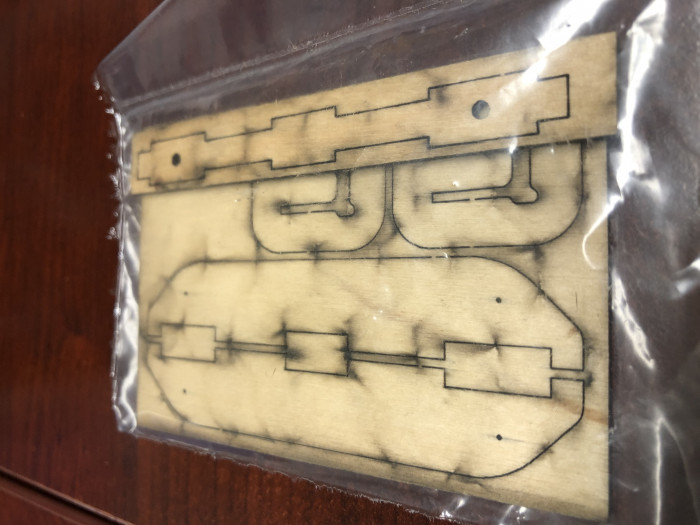
Tired of that out of kilter look you get from an off center tab? Maybe you just don't want re-glue your stab from time to time as often happens. This little kit builds into a U channel perfect for your stab. Glue or cross pin your stab in. Pre-drilled holes in base are correct diameter to thread 4-40 socket head bolts. These can be the same bolts that hold your conventional horizontal stabilizer on. Also, a must if your converting to T tail. There is no stronger way to mount the vertical stabilizer.
Slow stick parts come in both 4 and 5 mm. 4mm is .157" or pretty close to 5/32". 5mm is a little over 3/16" at .197". Measure your parts before ordering.
Aluminum tubes required to build a straight wing, no dihedral Slow Stick Wing set up. Easily Bent to your chosen Dihedral. Note the pre-bent GWS 12-degree tubes are discontinued. Good precision fit to factory 3mm spars and a little longer than factory part at 3" to reduce spar wobble inside of tube.
Use to offset a second boom from your main boom. Imgaine a Schiender cup racer but rather than a float centered under the fuse, we're adding a second boom. Original intention is to locate a second boom below your main boom to hold landing gear, battery and camera mount for FPV experimenters. In this way (with other parts available separately) Can be used to configure Slow Stick for single tractor motor with camera position in front of prop if you like.
Other uses are possible, perhaps you want to put a boom up above your wing to hold motor or camera above prop. Use your imagination with this special kit.
On model in photo parts are colored black with permanent marker. Made from laser cut 3/32 Aircraft Plywood. This kit offsets second boom with 4 3/8" gap.
Get rock solid control of your surfaces with these horns. Made to fit the precut Slow Stick holes exactly. No more wobbly bendy horns slopping up your flying performance. Ever wonder how much the in flight wind loads move them around? I say it does a lot and this is mostly because of the sloppy stock horns. Pick up a few MPH of wind and you can still fly with this mod. Also, she'll fly smoother when you actually get 100% of the throw you command. Solid control, that's where it's at!
Horn set is two complete horns, glue into the foam tail parts with foam safe CA. The horn is made from 3 parts providing lots of support on the surface of the horn. There is no substitute for straight stiff control rods, make sure your control rod setup is right to get the very best from these horns.
.400 wide by 8 5/8" long section of double sided tape. Used to mount Slow Stick vertical stab to side of boom. Many other uses possible. Genuine factory replacement part. SKU Number: GWAP088
Mounts two servos easily. Tired of the GWS mount splitting and pulling the grommets out of your servos every time you stop abruptly (crash)? A slow and tedious repair when you should be flying. Our mount is tied together to prevent this problem. Also allows mounting of servo set low or high relative to the boom.
Although you can use this mount to put the servos anywhere along the boom, we've found a great enhancement putting the servos right back at the tail and using the stock music wire for short pushrod wires. You'll get rid of pushrod wire weight but the real advantage is your eliminate tons of pushrod flex, your controls will tighten up and you'll find she handles a little more solid in a breeze.
Kit allows use of different size servos. I like 6 gram servos like Pico's and HS-55's on my sticks. You might think moving the servos back would cause your stick to become tail heavy but remember your eliminating pushrod weight and what your moving back wasn't up front, it was already somewhat to the rear already. We find it works out just fine and the model is still easily balanced.
Want to bolt on a perbent aluminum or fiberglass main gear? Here is the attachement for that purpose. A customer in our shop actually uses a monster overpowered Slow Stick as a tug for 3 meter sail planes. YIKES! His need for an ultra rugged gear attachment inspired this upgrade part. Rugged with plenty of surface area to drill to match your gear. Thread directly into the tough aircraft ply or use blind nuts. Provide your own fasteners or get them from our hardware section.
NOW PRECISIONS LASER CUT IN HOUSE & BACK IN STOCK!
Replacement Motor Stick for our Adjustable Motor Mount Mount Kit. Single ended stick with mounting slots. Each package 2 sticks. SKU Number: RRCSSAMMRMS
Build a 68-inch electric RC model of the 1905 Wright Flyer with Radical RC's open-framework, stand-off-scale kit. Assembly is required; this is a building kit rather than an ARF.
Kit and equipment
The kit includes pillow blocks for axle mounts if you choose to make your own landing gear. The pilot and flying wires in the example build were added by the builder and are not included.
Plan for a compatible radio and receiver, motors, propellers, ESCs, servos, wiring and a flight battery. The options below let you add motors, motor mounts, props, ESCs, rudder/canard and wing-warping servos, an extension/Y set, a battery, and connector or soldering work. These power-system and radio-equipment choices are separate from the base kit; review the selections before adding it to your cart.
Model specifications
Wingspan: 68 inches
Length: 46 inches
Weight: 52 ounces
Power: 200–350W
Development history and flying notes
Winner of "1st Place CD's Choice Award" Sunday July 8 at 2012 Mid America Electric Flies.
Thanks to Ken Myers and Keith Shaw for all the hard work on this event.
This kit is an outgrowth of our stand-way-off scale Wright Stick. These kits have flown with great success all over the world for years. Many have commented how cool it would be to have the correct color, wingspan and tip shape to make the kit even more scale like. One builder, Peter Sripol made his own Depron wings and flew his at SEFF in 2011. It flew very well and looked as controllable and gentle as the version based on Slow Stick wings. In 2012 there is a possible opportunity to fly at a famous Wright location. I wanted to have a model ready should that develop further. Also, I wanted a new and unique kit for Toledo this year, we decided now was the time. This machine has all the same struts as the original 1905 Wright Flyer. The 1905 was configured a couple different ways both prostrate and seated pilot and actually carried a passenger In 1908/1909 as the first military aircraft. It was the culmination of everything Wilbur and Orville had learned from the first 2 flyers. It has a longer tail and canard moment and was the first version that truly flew well. 2009 was the 100 year anniversary of Military flight. The flyer sold to the military was essentially the 1905 Wright model 3 with seating and control modifications. So, this is a 1905 or 1908 depending on what scale detail you add.
Our Wright Stick was historic in being the first ever sport type Wright Flyer. Our new stand off scale version follows all the same scale lines in all areas possible while still keeping the model simple and rugged.
This is our second open framework kit. We hope to produce a few more in this style. A Curtis Pusher is high on my list as is the Wright EX (Vin Fizz) or perhaps the Wright B Flyer. This is a kit and not an ARF. However it assembles more like an erector set. It will fly well and you'll certainly draw a crowd. I suggest you fly it over a grass field and 10mph wind or less. I've flown in as high as 16mph but less is certainly more fun.
Low pass and climb out photos are of Steve Cushing's build. He's added some scale detail such as flying wires and pilot (not included in kit)
Picture shows kit with bent and painted depron wings. Yes, it will slide along pavement and ROG if you like. Pillow blocks are included for axle mounts if you'd like to create your own landing gear.
Like all Sig Kadets, the LT-40 behaves perfectly in flight, with true "hands off" stability on all axis. If the student pilot gets disoriented, simply let go of the control sticks and the LT-40 will recover itself and return to level flight within seconds.
Because the Kadet LT-40 is bigger than the average .40 size trainer, it has a much lighter wing loading, which lets it fly slower! Slower speed gives the student pilot more time to think and react to what the model is doing, thus making it easier to learn to fly R/C. Every major part of this kit has been pre-shaped, sawn, die-cut, laser-cut, routed, or whatever it takes to make it ready-to-install right out of the box.
Setups below would be my first picks depending on your purpose for the model. If your trying to learn or train a beginner, or just want a mild model with enough power to get out of trouble, pick setup around 1000 to 1400 foot per minute climb rate (fpm). An expert can do quite nice aerobatics on 1000 fpm, 1400 fpm and above is enough for first season pilots. Setups 2000 fpm and higher is agressive power.
Specifications:
Wingspan 770 in 1778 mm Wing Area 900 sq in / 58 sq dm Weight 5.5 - 6 lb 2494 - 2721g Wing Loading 14 - 15.5 oz/sq.ft. 4272 - 4730 g/sq-m Radio Required 4-Channel Recommended Engines .30 - .40 cubic in (4.9 - 6.6 cubic cm) 2-Stroke .40 - .50 cubic in (6.6 - 8.2 cubic cm) 4-stroke
Special notes about electric from Dave: This model makes an excellent electric conversion and is perhaps the most popular one of all time. Super light weight, large as or even larger than many 60 size trainers. For UAS purposes, the under wing compartment is 3" wide, 5 5/8" deep and 12 3/4" long.
Setup and Performance Chart
Motor
# Cells
Prop
Amps
Watts In
RPM
Thrust oz.
Pitch Speed MPH
Climb FPM
Est. Top Speed
Himax 3528-800
3
12x8
36.1
406
7,020
57
57
914
44
Himax 3528-0800
4
11x5.5
34.8
522
9,880
59
51
1131
47
Himax 3522-990
4
11x7
40.8
612
9,520
76
63
1319
51
Himax 3528-800
4
10x6
40.1
752
12,320
86
70
1541
55
Himax 3528-1000
4
10x5
42.2
633
12,260
74
58
1274
50
Himax 3528-1000
5
10x4
50.5
947
15,090
97
57
1758
55
Himax 5018-530
4
13x10
33.9
497
6,580
72
61
1236
50
Himax 5018-530
5
12x8
31.9
598
8,490
83
63
1455
53
Himax 5018-530
6
12x8
42.2
950
9,840
115
73
2201
61
Himax 5018-530
6
13x8
52.1
1172
9,360
136
69
2734
65
Estimates based on manufacturers provided constants using E-Calc. High Quality 2100-3000mah used as trial cell in calculations. Presumed model weight of 95oz. @3 cells (added oz for higher cell counts). Actual performance may vary depending on components used, accuracy of data as provided by manufacturer, quality of battery, ESC, and many other factors.
Temporarily out of stock, pending manufacturer production
Mounts one servo easily. Tired of the GWS mount splitting and pulling the grommets out of your servos every time you stop abruptly (crash)? A slow and tedious repair when you should be flying. Our mount is tied together to prevent this problem. Also allows mounting of servo set low or high relative to the boom. Great way to mount your single servo for nose gear, camera or drop box actuation. Maybe you want to move one servo back to the tail and eliminate some pushrod slop? Whatever the case, our mount gets the job done cleanly.
Tip: This shot shows how to use a section of fuel line to connect a control rod. Slips easily in a bump and quick to adjust.
First attempts at R/C flying should be with an inherently stable model that flies slow enough to give the student pilot time to think and react. The Kadet Senior is the result of designer Claude McCullough's 50+years in the model airplane hobby. Everything about the Kadet Senior has been designed to make it the easiest to fly trainer in the world.
The"Hands Off" Trainer; High-wing configuration, large tail surfaces, and generous dihedral for true "hands off" stability. The Kadet Senior flies so slow and gentle that just about anyone can handle it on their very first try! If the student pilot gets confused, simply let go of the control sticks and the Kadet Senior will recover itself and return back to level flight. Flat-bottom airfoil, light weight construction, and a super light wing loading allow the Kadet Senior to cruise around at low speeds. All-balsa design with a strength-to-weight advantage that ARF trainers can't approach
Specifications: Wingspan: 78 in 1981 mm Wing Area: 1150 sq in / 74.2 sq dm Weight: 6 lbs / 2720 g Length: 62 in / 1575 mm Radio Req.: 3 Channels, 3 Servos Engine Req. .29-.40 cu-in / (4.8 - 6.5 cu-cm) 2-Stroke Glow / .35-.45 cu-in (5.7 - 7.4 cu-cm) 4-Stroke Glow

 "Radical RC Quad Copter Designers Kit")


 "Slow Stick Battery Tray Mount Kit, Standard Length")
 "Partial* Slow Stick X / X Trainer Tail Repair Kit, missing part(s) - SOLD AS IS*")
 "Slow Stick Battery Tray Mount Kit, Long")
 "Screw Set For Slow Stick")
 "Slow Stick Boom Stop Set")
 "10mm Radical RC Woody Boom Kit (2 Ea 24 Inch sections)")
 "Slow Stick Bipe Wing Strut Bushings")
 "Carbon Wing Rod Set for Slow Stick")
 "Slow Stick Wart Hog Twin EDF64 Fan Adjustable Mount Kit")
 "Slow Stick Vertical Stabilizer Mount 5mm")

 "Slow Stick Aluminum Straight Wing Tube Set")
 "Slow Stick Offset Boom Mounts")
 "Slow Stick Control Horns Set")
 "Double Sided Tape For Slow Stick Tail")
 "Slow Stick Dual Servo Mounting Kit")

 "Slow Stick Bolt On Main Gear Mount Kit")
 "Slow Stick Twin Prop Drive Replacement Motor Sticks")
 "Slow Stick Adjustable Motor Mount Replacement Motor Sticks")
 "Slow Stick Adjustable Pusher Motor Mount Replacement Motor Sticks")
 "Radical RC 1905 Wright Flyer Kit")


 "Sig Kadet LT-40")
 "Slow Stick Single Servo Mounting Kit")
 "Sig Kadet Senior")