
Regular thin CA will eat a hole through white foam while you stand there watching it. If you build with foam you need adhesives that leave it alone, and you need to know which one suits the joint in front of you. Here is how we sort out the foam safe shelf at the shop.
Why Regular CA Attacks Foam
Standard cyanoacrylate gives off heat and solvent as it kicks, and expanded foam has almost nothing there to absorb either one. The foam collapses and you get a crater. Foam safe CA is reformulated so it does not do that. It also happens to be odorless, which is why people who have grown sensitive to normal CA fumes often end up using it on everything, not only on foam.
Foam Safe CA
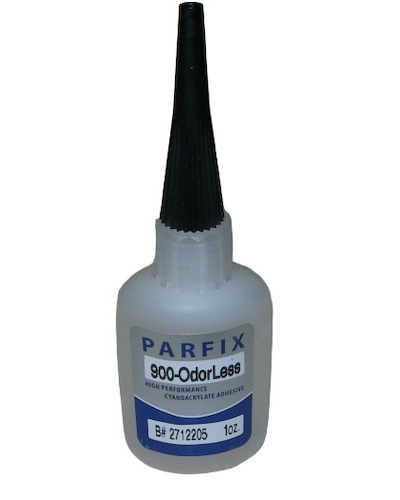
We carry PARFIX 900, a one ounce odorless foam safe CA in a low to medium viscosity. It wicks into close fitting joints and leaves a low bloom cure on plastics. For thicker work, Satellite City’s UFO is a thick foam safe CA that fills gaps and suits laminating and planking, with a longer working time than a thin CA.
A word about accelerator on foam: go easy. Spray it into the air and waft the part through the mist rather than hitting the joint directly. A micro dusting is all you need. Too much accelerator brings back the same heat problem you were trying to avoid, and it will frost the surface.
Epoxy on Foam
Epoxy is what you want where a joint has to carry load and stay slightly flexible. Firewalls, landing gear blocks, wing bolt blocks and fuel proofing. Choose the cure time by how much working time the job needs, not by how quickly you want to be finished.
| Cure time | What it is for |
|---|---|
| 5 minute | Quick repairs and small joints where you are not fiddling with alignment. PARBOND 5 Minute comes in 4 and 8 ounce sets, and the Devcon 5 minute twin applicator is handy for one small joint at a time. |
| 15 minute | The middle ground, for when a 5 minute set is rushing you. |
| 30 minute | Larger assemblies, several joints at once, and wetting out small fiberglass sections. PARBOND 30 Minute comes in 4 ounce and 8 ounce. |
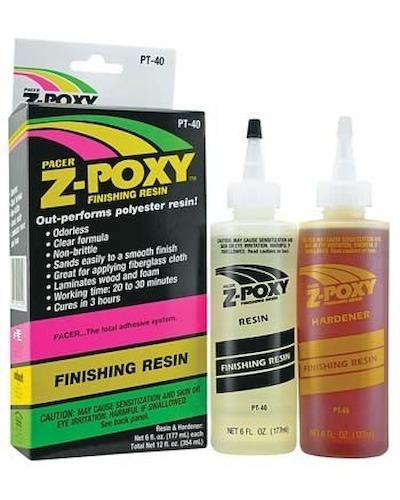
| Finishing resin | Z-Poxy Finishing Resin gives 20 to 30 minutes of working time and cures clear in about 3 hours. This is the one for glassing over wood and foam. |
Hint. Mix your epoxy on something flexible like a paper plate, then go back to the leftover puddle a week later and flex it. If it cracks like glass you are not measuring or mixing it properly. A good epoxy joint is strong and still has some give to it.
If you need a 30 minute mix to kick sooner, warm the joint with a covering heat gun. Be careful. Heat thins the epoxy first, so it can run out of the joint and make a mess, and a little heat goes a very long way.
Foam Glues and White Glues
For foam to foam work there are better answers than CA.
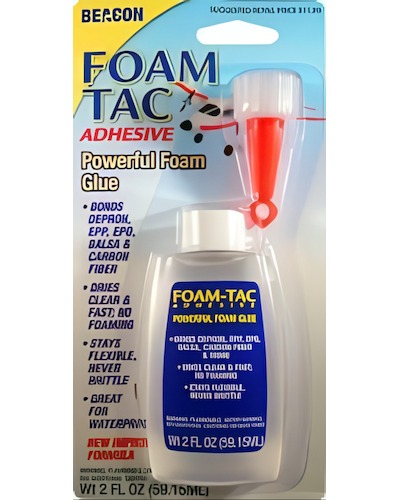
Foam-Tac bonds Depron, EPS, EPP, XPS and EPO as well as carbon fiber and wood. It dries clear and flexible, never goes brittle, and takes far less glue than a CA to make a permanent joint. It will not glue your fingers together either.
Deluxe Materials Foam 2 Foam is a single part, very high tack glue for Depron, EPP and EPO along with wood and plastic. It grabs hard but still lets you adjust the part.
Foam-Cure from Bob Smith is silicone based and works well on EPP and EPO. It is not an instant bond and there is no accelerator for it. The trick is to coat one part, join the two, pull them back apart, let it air dry about ten minutes, then rejoin. At that point it behaves like a contact cement and holds well enough to keep building on. Full strength comes at 10 to 12 hours.
Sig-Bond is an aliphatic resin, much like white glue but stronger, and it is foam safe. You work maybe half as fast as with CA, which is exactly what you want when a joint needs aligning. It is a popular choice for people with CA allergies.
Canopies and Finishes
Keep CA away from a canopy. It fogs clear plastic. Pacer Formula 560 canopy glue dries clear and flexible, cleans up with water, and holds vacuum formed ABS parts through vibration. For finishing foam, Deluxe Materials makes Foam Armour along with a Foam Finish in gloss and matte.
All of it is on the foam safe epoxy and glue page. The regular thin and medium CAs for balsa work are under CA (Cyanoacrylate), and the rest of the epoxies are on their own page.